I Love the Tribe

We just got back from Worldcon 2005 at Glasgow, and I’ve been reading through the blogs of various friends checking for mentions of me, like a senior counting pictures in a school yearbook. Having come home to three lovely houseguests, I don’t have time for my own detailed con report, so sorry if you’re combing this blog for a mention of yourself. But I will proclaim these words:

I love the tribe. I went to parties where almost every conversation was fascinating. I can meet at least ten cool new people in a matter of four days. The future is in good hands.


The Hugo Awards happened here, yo.

What I’ve realized is that a science fiction convention has the same emotional arc as a really excellent five-day wedding. The pre-travel wondering if you can get out of it. The reunions with con-friends, whom you see as infrequently and love as much (and can tease as hard) as family. The cool new people you bond with over the parties, ritual gatherings, not enough sleep and too much drinking. The central event you get dressed up for—Hugo Awards Ceremony, World Fantasy or Nebula Awards Banquet, the Tiptree Auction—that you’ve all supposedly come long distances for. And those parties after the Big Event, your last chance to drink a lot and proclaim that the marriage is doomed, or that the Hugo went to the wrong short dramatic presentation.

And like a really fabulous extended wedding, I am always a bit mushy at the end. Leaving all those new and old friends is painful, and coming back into the real world can be a bit harsh. Especially dealing with all those outsiders who are so indifferent to the special rules of the place where you’ve just been.

Take, for example, coming home to the New York Times’ review of Kelly Link’s new book, which was generally positive but contains this astonishingly mundane line about her story “Zombie Contingency Plans”: “The premise is fresh and the characters are likable . . . but . . . those zombies–are they supposed to be a metaphor?”

Argh. Are those not of the Tribe really so dim-witted? Are our skiffy reading protocols really so hard to understand?

Allow me too explain, Mr. Non-sf-Reading Reviewer Man. Sure, zombies can “be a metaphor.” They can represent the oppressed, as in Land of the Dead, or humanity’s feral nature, as in 28 Days Later. Or racial politics or fear of contagion or even the consumer unconscious (Night of the Living Dead, Resident Evil, Dawn of the Dead). We could play this game all night.

But really, zombies are not “supposed to be metaphors.” They’re supposed to be friggin’ zombies. They follow the Zombie Rules: they rise from death to eat the flesh of the living, they shuffle in slow pursuit (or should, anyway), and most important, they multiply exponentially. They bring civilization down, taking all but the most resourceful, lucky and well-armed among us, whom they save for last. They make us the hunted; all of us.

That’s the stuff zombies are supposed to do. Yes, they make excellent symbols, and metaphors, and have kick-ass mythopoeic resonance to boot. But their main job is to follow genre conventions, to play with and expand the Zombie Rules, to make us begin to see the world as a place colored by our own zombie contingency plans.

That’s why I spent last weekend drinking Scottish ale and discussing in great detail the seven different kinds of elasticity in time travel, the four major flavors of alternate technological history, the author’s duty of care in making military far-future hierarchies believable, and which nationalities of vampires can go out in the sun (Japanese, Swedish, discuss). And yes, I did spend some time talking about how I’d get out of the Glasgow Hilton hotel bar in case of zombie attack.

Don’t you see why this is more vitally important than your poxy metaphors, Mr. Times-Reviewer-Man?

Stories are the original virtual reality device; their internal rules spread out into reality around us like a bite-transmitted virus, slowly but inexorably consuming its flesh. They don’t just stand around “being metaphors” whose sole purpose is to represent things in the real world; they eat the real world.

Which made it rather painful to finally lift up our heavy luggage and come home, to live again among all these people who see the operations of language and storytelling in, quite frankly, a sophomoric English-class sort of way. All these people with their appalling lack of zombie contigencies. (Or maybe their dim-wittedness is, like, supposed to be a metaphor. What the hell do I know? I’m just a science fiction writer.)

Anyway, I really had a good time. Thanks to Glasgow, and all the organizers and volunteers, for lifting me out of the real world for a while. You rule.

Plus . . . Orbit, the UK publisher of Risen Empire, bought Midnighters for their young adult line.

W00t! Midnighters with slightly different spelling and punctuation! And with many more readers!

Glasgow was my first time meeting the Orbit crew, and they were all extremely cool. I look forward to publishing many more books with them in the future. (And the sale makes that whole pound-sterling-eating mother of a trip totally tax-deductible. Righteous!)

Gone to Scotland

Like the rest of the Tribe, I’m headed off to Scotland for the World Science Fiction Convention. Worldcon will consist of about 6,000 of us skiffy-heads talking about the death of publishing, the probable shape of the future, and the state of Scottish cuisine. And possibly we’ll also be drinking beer.

I may or may not be posting much, but like all such affairs, Worldcon will be extensively photoblogged, warblogged, and real-time transcribed. Five minute’s research will no doubt turn up embarrassing photos of me or any other sf writer you’d care to google.

Actually, it doesn’t start until next Thursday, but in the meantime we’ll be staying in London with Justine’s sister Niki and our pals Lauren and Andrew. Have to make up for all those lost tourism dollars, bravely ride the underground, stiff upper lip and all that.

Here’s my Worldcon schedule:

Thursday 8:00pm The Military – Getting It Right
Does it matter if we don’t get the equipment right? Is it ok for fictional military characters to sound like boy scouts? Is there a military ethic that we have a duty to get right? What matters to readers in uniform? With Simon Bradshaw (M), Paul Chafe, Richard Morgan, Scott Westerfeld, and Karen Traviss.

Ever since I wrote the space operatic Risen Empire, I’ve been put on military panels. This topic is a bit more focused than most, however, and look interesting. Of course, the answer to all the question depends on what you mean by the military: Imperial storm troopers grown in a vat? Or 19-year-old reservists with Arab phrase books trying to quell 4,000 years of Babylonian bloodshed?

Friday 11:00am Why Write for Children/YA?
A recent advertisement for a Canadian first novel award included the line “if you have previously written children’s books, you are still eligible.” With that kind of attitude, why do we bother? With Julie Bertagna, Oisin McGann, Janet McNaughton, Sharyn November (M), Scott Westerfeld, Jane Yolen.

Dude, I’m on a panel with Jane Yolen! This should be fun, although the petulant tone of the description strikes me as odd. Didn’t they get the memo about how YA rules the world? And how everyone and their dog is switching over? (Except Walter Mosely’s dog, who’s writing a science fiction novel. Sucker.)

Saturday 1:00pm Autographing
Me and James P. Hogan, Justina Robson, Liz Williams, and Charles Stross.

Monday 11:30am-12:00pm. Reading
I’ll probably read from Risen Empire, seeing as that’s my only book out in the UK this year. Uglies doesn’t reach those shores until spring 2006.

That’s it. The rest of the time I can be found in the bar. You know, that bar in Scotland.

Church sign courtesy of the Church Sign Generator.

Hunting the Snark (updated!)

Whenever I see my writer friends react to reviews, I’m reminded of a certain Gary Larson cartoon:

Owner says to dog: “Get the stick, Rusty! Come on, get the stick! Good dog, Rusty! Isn’t Rusty a good boy!”

Dog hears: ” – – – – – Rusty! – – – – – – – – – – Rusty! – – – – Rusty! – – -.”

But it’s not our names that we writers get all hyper-aware about in reviews. It’s the snark.

Here’s an example: I once wrote to congratulate a friend of mine whose new novel had just received a fabulous, glowing review in Publisher’s Weekly. She wrote me back a one-word email: “Overwrought?!?!?!”

Oops. I hadn’t noticed that one bit of snark among all the praise. I had read the following words, “This extraordinary and accomplished novel, while overwrought in places, is hands-down one of the best books written this year, maybe of all time!” But my friend had seen only, “- – – – – – – – – overwrought – – – -!”

This Rusty-dog-like vision is why when writers see emails from their publishers with the subject header KIRKUS REVIEW, we flinch a bit. Okay, we flinch a lot. Kirkus must have some sort of snark-inclusion rule in their guidelines, and their anonymous reviewers follow this rule with relish. Even in their most positive reviews, there is always at least one damn phrase guaranteed to gets up the author’s nose.

Being as Rusty-dog-like as the next writer, I remember exactly two words from the Kirkus School Library Journal review of Uglies: “although lengthy.” (Gads. It’s that “although” that kills me. Like “lengthy” things are such a trial. “Although lengthy, my vacation was very enjoyable.” “Although lengthy, our marriage is a true union of two souls.” “Although lengthy, World War II defeated facism and saved democracy.” Argh.)

So when my upcoming Kirkus review of Peeps appeared in my in-box, I braced myself. (Plot purists take note, mild spoilers.)
 
(STARRED) Both medical thriller and science fiction, this fast-paced, captivating modern vampire story is enriched with biology and history. Nineteen-year-old Cal is a hunter. He works for the Night Watch, New York City’s clandestine organization to capture “peeps,” “parasite positive” people infected with an ancient disease that causes vampirism. They’re cannibalistic, violent and wildly strong. Cal tracks his line of contagion: an exgirlfriend, whom he unwittingly infected, and then his progenitor, the girl who gave it to him. Yes, Cal has the parasite, but he’s a carrier rather than a full-blown peep. Forced into secrecy and celibacy but possessing peeplike superhuman senses and strength, Cal simmers with adrenaline. He succeeds at his job in the dank, oppressive urban undergrounds, but he discloses secrets to an unauthorized, uninfected girl his age who becomes inextricably involved. Conspiracy issues arise; the parasite’s centuries-long history holds a profound revelation. Westerfeld intersperses relevant chapters on how various real-life parasites operate in nature. Entrancing throughout–but squeamish readers beware. (afterword, bibliography) (Science fiction. YA) (Aug 1 issue)

Rusty says: Not much snark here at all! In fact, it seems that the snark-quota was entirely expended in the phrase, “but squeamish readers beware.”

But this is good snark, because it will bring the non-squeamish running in droves! So when I performed my second writerly duty (after snark hunting) and cut the review down to a jacket blurb, here’s what I came up with:

This fast-paced, captivating modern vampire story is enriched with biology and history. Entrancing throughout–but squeamish readers beware.

See? The snark is in the jacket quote! Hah! Snark on that, anonymous Kirkus-oid!

My only regret is that they didn’t put an exclamation point after the word “beware.” That would have been much cooler. Maybe I’ll just, you know, add one. Who would notice?

ONE MORE THING: The release date for Peeps has been moved up to August 25. That’s four weeks and three days from now!

ONE OTHER MORE THING: Kirkus reviewers are the kindest, bravest, warmest, most wonderful human beings in the whole world. Any implied disrespect was for humorous purposes only. ‘Nuff said.

___________________________________
UPDATE! (in the sense of humiliating retraction)

OMG! I just got an email from my no-longer-anonymous Kirkus reviewer. (Not anonymous to me, anyway. I shall name no names.) She informs me that those haunting words “although lengthy” are actually . . . not from Kirkus! That review was from School Library Journal.

Mea culpa, oh, quasi-anonymous one!

It just goes to show you that although memories can be haunting, they don’t have to be, you know, accurate. So, like I said, Kirkus reviewers are the kindest, bravest, warmest, most wonderful human beings in the whole world. And this time, it is meant without the Manchurian Candidate vibe.

Die Uglies

No, not Die as in “Cease to Live!” Die as in “The.”

That’s right, Uglies is soon to be translated into German.

The publishing company is currently deciding between two titles for this edition. Perhaps they’ll use the more faithful translation Die Haßlichen, meaning simply “The Uglies.” But there has been talk of going with a more descriptive title, such as Die Haßlichenweglaufenzugesichtersparenkinder. This teutonic mouthful means literally “the ugly away-running to save faces kids.” It should look very imposing on the cover:

(Apparently, the plot of Uglies has been used before in German literature. I mean, they’ve already got one word for the whole concept!)

I also received news today that Italian rights have sold. The Italians, however, have opted to buy only the first two books of the trilogy. It seems their clever spies have overheard my midnight screams as I attempt to finish Specials before leaving for Worldcon. Bastardos!

Despite their caution, I’m very pleased about Italians joining the party. As I explain in detail here, I had a friend in college who used to crack me up with literal translations of Italian movie titles. One day, she explained that the wacky comedy known here as Airplane was called “The Craziest Airplane in the World” in Italy. After learning this, my friends and I spent the next four years refering to all movies using this template. Thus:

The Godfather became “The Craziest Family in the World.”
Jaws: “The Craziest Fish in the World.”
All the President’s Men: “The Craziest Quaker in the World.”

Now that I will finally have my own work in Italian, I’m going to insist on title approval in the contract. So which do you think I should go with:
“The Craziest Facial in the World”
“The Craziest Cosmetic Dystopia in the World”
“The Craziest Hoverboards in the World”
“The Craziest Ugly Away-Running to Save Faces Kids in the World” . . . ?

Okay, me stop now. (Any more suggestions?)

Anyway, these two sales makes the Uglies trilogy my most translated work, beating Risen Empire by one language. Go Simon & Schuster foreign rights department!

(And special thanks to niece Renee for helping with the German.)

Harry Friggin’ Potter

New York City is mental tonight. In addition to all the usual crowds around bars and nightclubs and street performances, there are all these huge lines in front of . . . bookstores.

Justine and I were walking home from seeing the Liberty at Madison Square Garden, and stopped at out usual post-game restaurant at about 10PM. Already, there were families out with their hyped-up kids, lightning bolts on foreheads and big geeky glasses on. The buzz was already in the air.

After dinner, we decided to visit the Union Square Barnes and Noble. It had all the usual signs of NYC madness. There were rented searchlights sweeping the sky, giant lines and gianter bouncers, and that all-important symbol of more demand than supply: a wristband system. Folks with yellow wristbands were the lordly pre-buyers. Lesser minions were assigned orange bands, with numbers scribbled on each one showing the order of arrival.

Over at the fabulous Books of Wonder was an even vaster line. Two lines, actually, stretching in both directions to either end of 18th Street between 5th and 6th. There were wizards, bouncers, snipers, all the usual elemants of a book-release party.

We wanted to see our pals who work at the store, just to get the business-end vibe of all this madness. Also, I figured that this was probably the only overcrowded NYC event where YA-writer status was a red-velvet-rope-cutting superpower. Justine was like, “Don’t embarrass me.” But I went to the front of the line and spotted friends, who waved us in all official-like.

Whoa, those were some tired faces. The BOW crew had all been up since dawn organizing and strategizing and lugging vast quantities of books up from the basement. And here they were some 18 hours later, wearing pointy hats and facing a mob that would be surging into the store in only ten minutes . . .

But actually, they kind of looked like they were having fun.

Whatever you think of JKR, tonight was really amazing. Here were thousands of people within a few city blocks all having a genuine cultural event. And it wasn’t about a movie star or a politician or a sporting hero . . . it was about a book. (Hey, any night on which mid-list young adult writers magically obtain line-cutting powers is okay by me.)

It reminded me of a story about Charles Dickens’ popularity. When he was serializing The Old Curiosity Shop in 1840-1, the US was a week or so behind in the narrative, because the magazines had to be brought here by sea. One of the characters, Little Nell, got sick in that Dickensian way where you can die at any moment. So reporters used to hang around the docks when cruise ships arrived from England, and shout up at the passengers before the gang planks had even been lowered: “What news of Little Nell?”

That was probably the last time people got so exercised about a fictional character, you know?

Of course, Justine and I got the heck out of Books of Wonder before the appointed hour arrived, letting the people who’d waited in line have their due, and letting those brave souls at the cash register do their jobs.

My heart goes out to bookstore employees everywhere. I hope you all survived.

Boats Are the New Black

Last week, Justine and I were privileged to go on our Razorbill publisher’s sailboat for July 4. Tonight, we got a taste of fireboat!

Back in 2000, when John Oakes was the owner of Four Walls Eight Windows, he published my adult sf novel Evolution’s Darling. We’ve kept in touch ever since, and he still invites me to his annual fireboat party.

This is an excellent thing, because fireboats are big, powerful tugboats armed with water cannon! A fireboat party consists of cruising around Manhattan drinking beer, eating sausage, and ocassionally firing the water cannon straight up into the air.

This is what a bunch of publishing people on a fireboat look like:

They look like pretty much regular publishing people, but notice the water cannon over their heads. There’s something special about water cannon, something that adds a certain frisson to a publishing party. Maybe it’s the fact that at any moment, John Oakes may fire the water cannon, and metric tons of seawater will fall on all your heads!

This is my artistic shot of the Statue of Liberty, taken from the front of the fireboat. (This was a peaceful moment, before the water cannon had been fired.)

I wish I had pictures of the water cannon shooting into the air. But something about having metric tons of seawater falling on my head and being out of batteries made that impossible. Trust me, though, it was funny seeing all those publishing people trying not to get wet.

Next year I’ll bring an umbrella and fresh batteries. I promise.

One more thing: Last year, John sold Four Walls Eight Windows to Avalon Publishing Group. He’s working there now and publishing much cool sf and other stuff. Please go buy his books so that there will be a fireboat party next year!

Green Russians (updated)

In the comment thread for my 4th of July post, there’s been much talk about how well the cover gods have treated me. Yes, my covers have generally been excellent (through no efforts or skill of my own). And the really amazing thing is, although I have several publishers, my books mostly look like they belong together. Especially all those eyes. (Even the Midnighters 1 cover has an eye-thing going on, if you sort of squint.)

But to think such thoughts aloud is dangerous. Pride cometh before a fall.

Just yesterday in the mail, the cover gods sent me their comeuppance, the Russian cover for the Killing of Worlds:

Many questions arise: Who is that green woman with skunk hair? Why are they wearing Soviet spacesuits from 1971? Is that a giant camera floating in space behind the overweight Thunderbird 4?

Just so you know, there are no green characters in Killing of Worlds. And no giant space cameras. (Sure, there’s a mad psychic senator, a world-spanning intelligence, one cyborg commando, and a few space battles. But nothing weird, like, for example, skunk hair.)

The mysteries of Russian cover art are many. It seems the publishers there buy it from some giant source of fantastic art in the sky, and then mix and match willy-nilly. Leland Modesitt, who was kind enough to forward this copy to me, reports that he once had a Russian translation that included 30 pages of slick fantasy art, all of it unrelated to his novel.

Oh, well. At least the green lady has big eyes.

-UPDATE-

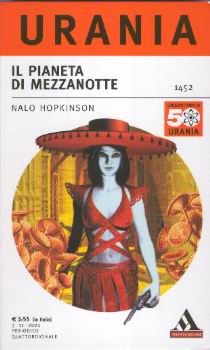
Oft-translated fabulist Nalo Hopkinson sent me this cover of the Italian edition of Midnighter Robber, featuring a blue protagonist. But at least if she has skunk hair, her bullfighting sombrero hides it.

Writing Advice 2

People in writing groups often ask me, “What do I do when I get conflicting advice? How will I ever decide which way to go?”

My answer is: “Try it both ways and see which works! Don’t just write one ending, write three!”

It’s a medically proven fact: Writing the same scene several different ways won’t actually kill you.

Take a cue from visual artists. They make a hundred pencil drawings of a subject before even starting with the paint. They paint the same dang pot of flowers a dozen times, with only slight variations. They doodle in their sketchbooks all day, making stuff no one will ever see. But they rarely sit there and just complain about a compositional problem without putting their hands on a brush/pen/piece of clay.

In my second novel, Fine Prey, I actually wrote a scene that I knew wouldn’t be in the final draft, just so I could visualize what had happened “off screen” in the story. Weird, but it worked.

In another case, I lost a short story and had to write it again from scratch. Then I found the original again. (Argh.) Guess what? The combination of the two–taking the best elements of each–was better than anything I would have reached by fiddling endlessly with that lost original. And the experience of writing a story twice and then comparing the two versions helped me understand it in ways I wouldn’t have otherwise.

You see, paper is magic: Making marks on it changes your brain. So, don’t sit around trying to think your way out of problems, write your way out of them. The best place to find answers is on a piece of paper or a glowing phosphorus screen.

One quick note
Of course, thinking about writerly issues in the shower or while jogging is a fine habit to get into, because otherwise that’s just wasted time.* Please understand that I’m not against thinking; I’m only against thinking that thinking on its own will get you out of a hole. Shovel also needed.

*Except for the being hygienic and fit, which is somewhat useful.

Writing Advice 1

The most common questions I get from fans (other than “when is Pretties coming out?”) are those about writing. Where do you get ideas? How do I get started? How do I keep going? How do you get published?

Of course, it’s not surprising that a lot of people who like to read also want to write. And fortunately, I love talking about the craft and business of writing. But I do find myself answering the same questions and giving the same advice again and again. So I’ve decided to start to put my stock motivational speeches together into a series of posts call, oddly, “Writing Advice.”

To give these posts visual interest and the appropriate authori-tie, I wasted many long minutes designing this exceedingly lame logo:

So let us begin at the end:

Finish everything!

There will always be a part of your brain that wants to give up when characters aren’t behaving, when you don’t know where to go next, when the inspiration has faded. Don’t give the start-something-else part of your brain any extra leverage, or it will win every time. And once it starts winning . . . Well, let’s just say that the not-finishing habit is a hard one to break.

It’s easy to think up logical reasons to stop writing a story. You say to yourself: “This sucks. Why waste any more time? I’ll start something new that inspires me!”

Yeah, well, the inspiration of a new story is exciting. But if you wind up not finishing ninety percent of what you start, guess what happens. After a few years you’ll have written 100 beginnings, 40 middles, and only 10 endings. Which means you’ll be great at writing beginnings, only so-so at middles, and you’ll suck at endings. Which means you will almost certainly keep faltering between the middle and the end of every story, which means you’ll keep giving up and not finishing . . . Rinse, repeat.

And that’s a hole you don’t want to fall into. So finish, even if you know this story isn’t going to win you the Nobel Prize—it’s good practice to type THE END.

Library Event, Uglies in French

First, some event news.

On Tuesday, July 12, Justine and I will be appearing at the Donnel Library in New York City. This is a Teen Central event, which means that only people 12-18 are allowed in. (No littlies or crumblies.)

We’ll be talking about Magic or Madness and Uglies, and generally attempting to be entertaining. Here’s where it is:

Donnell Library Center
20 West 53rd Street
(212) 621-0619.

In other news, Pocket Books in France has made an offer on the Uglies trilogy.

Yay, France! They have now taken all three Uglies books, plus So Yesterday, Evolution’s Darling, and The Risen Empire. They are now ahead of all non-US countries in publishing my work, including Britain and my adopted Australia.

Also, I get great press there. So, I’m like the Mickey Rourke of science fiction, or something.

People studying French, what will the title be?