A fan wrote me today with a bunch of excellent questions, and posting my answers here is easier than, you know, actually blogging.
Hi, Mr. Westerfeld/Scott (whichever you prefer). I really like your Midnighters books. I plan to be an author someday, so could you answer me a few questions?
Yes, I can. And I prefer Scott, except when people are trying to sell me something. (Then, “Mr. Westerfeld” will do.)
1. What is the hardest part of being a writer?
The vast emptiness of the blank page. You start to think about a story, “So there’s this girl with a dog . . . ” And a voice pops up and says, “Wait! What’s her name? Age? What year is this? What country? Is she poor? Rich? Middle class? Does she like monkeys, or just dogs? What about cheese? Is there magic in this world? What kind? Can the dog smell the magic? Hey, what kind of dog is it, anyway?”
See what I mean? There are so many different things you can write about. It gives me a headache sometimes.
Also, writing is kind of lonely profession. You’re all alone with that computer screen all day, unless you’re very clever and marry another writer.
2. What is the easiest part of being a writer?
The all-important writing uniform. Pajamas are comfortable and easy to put on. Socks, optional.
3. Do ideas come to you easily?
Yes. Ideas are easy, words are hard.
4. Is it hard to be published?
Yes and no.
On the one hand, there are millions (no really, millions) of people out there who want to be published. Every publishing house in the world has mighty stacks of manuscripts waiting sadly to be read. Every literary agent gets dozens (at least) of query letters a day, all begging for their attention. Everywhere you go, you’ll meet lots of people wanting to be writers.
On the other hand, a lot of those people are totally hopeless. Half of them don’t ever write anything. And half of them that do never send their stuff anywhere. Then subtract all the ones who can’t spell, can’t type, or who just can’t tell a story. And suddenly . . . there’s a lot more breathing room.
But persistence is required. (Imagine if you asked someone for a date, and they didn’t get back to you for six months, and then said no. And then imagining asking them again for a date. That’s publishing.)
5. How long did it take you to write your first book?
I started it on Mother’s Day, 1992. I spent more than a year on it, put it away for a few more years, then worked on it some more. It was first sent to an agent in 1996. (But after that, it all went pretty fast, and the book, Polymorph, was published in 1997.)
6. Do you receive a lot of fan mail?
Two today, which seems about average. (Not all of them are as complicated as yours, though. Not that I’m complaining.)
7. When did you decide that author was the right job for you?
Before I was one.
For me, there’s nothing more fascinating than novels. Most are created by only one person, even though they’re one of the most complicated things that humans do. Authors have to be the architect who draws the overall plan, the foreman who makes sure the work gets done, and the welder who puts in every bolt and rivet. (And then you have to research whether welders actually put in rivets or not, or some piss-ant will write you a letter about it.)
And as a science fiction writer, it’s even crazier. In the same day, I’ve had to decide the fate of humanity’s future and then had to check if “scumbag” has a hyphen or not. (It doesn’t.)
8. What book was the funnest to write?
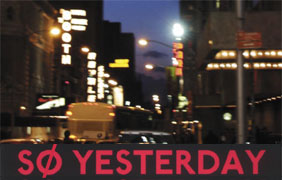
Probably So Yesterday. I wrote it after living in Sydney for a year and a half. I had just come back to New York City, so it was a sort of love letter to a place I’d lived in for 16 years but was seeing anew. The story just flowed out of me. It’s also the most comedic of my novels, and it occasionally slew me.
9. Do you know other famous authors, being one yourself?
Ahem, you are too sweet. But I’m not sure if I’m exactly “famous” at this stage in my career . . . I will leave that for my biographers to decide.
But I do know many wonderful writers, and seem to be meeting more all the time. Hanging out at publisher’s parties at conventions and book expos is an excellent way to meet your childhood idols, which is quite a fringe benefit.
10. Do you have any children?
Nope. (They might tell me my kid-slang is wrong, after all.)
11. Does writing ever get in the way of family?
Fortunately, I’m married to an author, so writing is the family business. We talk about our books all the time, go to visit publishers and to conventions together, and read our work to each other at night.
“The family that writes together, smites together.”