1000 Sk8rs

Update: It’s the 4th of July, so I won’t be posting today. Relax. Go watch fireworks and quit hitting refresh!

A few post ago, I covered the crumbling building across the street. Well, as my pal Scalzi mentioned on his blog, earlier that afternoon a horde of skaters roared down my street as part of Go Skateboarding Day.

I took video of them, but I was lame back then and wasn’t into posting video. But I am no longer lame!

I’ve finally joined the 21st century (or at least the latter half of the first decade thereof) and am posting video of the event:

They filled the avenue, baffled traffic, and took about ten minutes to all go by. The roaring was audible way up here on the seventh floor through double-paned windows! Reader, it stirred the blood.

And after you watch the video: Be kind, rewind.

Extras, Page 1

Here you go:

And thus ends page one. That’s actually the first page as it appears in the sample booklets handed out at BEA. (It’s more or less the final text, but a couple of words will be different, because there’s always these editors around editing.)

Oh, by the way, I now have several dozen of these samplers:

That’s them sitting on my chair. So many of them! What shall I do with them all? Maybe this . . .

Between now and October 2 the FIRST COMMENTER of each post, including this one, will get a copy of the sampler sent to them! Autographed! By me! To them!

Here are some tips:

1) Make sure that you’ve filled out your email address in the comment log-in box, so I know who you really are.

2) You don’t have to post your address in the comment itself. Just in the log-in thingie.

3) DON’T put your snail mail address anywhere online! I’ll email you and get that.

4) One per person! If you’ve already won on a previous post, be nice and let others conquer.

Remember, this applies to the first commenter only on every post between now and October 2.

Let the commenting begin . . .

It’s Cat Week!

Because we were just doing feline-borne parasites, check out this article about cats in the Science Times:

Some 10,000 years ago, somewhere in the Near East, an audacious wild cat crept into one of the crude villages of early human settlers, the first to domesticate wheat and barley. There she felt safe from her many predators in the region, such as hyenas and larger cats, and the rodents that infested the settlers’ homes and granaries were sufficient prey for her.

Seeing she was earning her keep, the settlers tolerated her, and their children greeted her kittens with delight.

At least five females, of the wildcat subspecies known as Felis silvestris lybica, accomplished this delicate transition from forest to village, scientists have concluded, based on new DNA research. And from these five matriarchs, all the world’s 600 million housecats are descended.

That’s right, scientists are now theorizing that cats and humans go back 10,000 years. That’s way before the Egyptian empire existed to immortize its felines in onyx, back to the beginnings of argiculture. I’ve always loved the notion that cats have been with us since the dawn of civilization, guarding our storehouses from the rats and mice. Maybe without these allies, the whole settling-down-and-farming thing wouldn’t have worked, and we’d still be hunter-gatherers.

There are two new finds of interest:

1) A cat was recently found buried with its human owner in Cyprus, in a 9,500-year-old grave. So they’ve been domesticated long enough.

2) Housecat mitochondrial DNA has been traced back to five original females. So the alliance may have started in a single village!

I’ve already covered cat-human alliances in Risen Empire and Peeps. But wouldn’t a novel set in a stone-age village, about the first cats to tie their destinies to humanity’s, be kinda cool?

Cat Scat Fever

The NY Times has an article on parasites today that has some weirdly familiar language.

Predators want to kill you and eat you right there on the veldt. Parasites, by contrast, want to keep you alive, the better to serve as a parasite paradise, a cozy haven where they can grow at their own pace, suckle on your moist, nourishing tissues, multiply their numbers and finally, one way or another, pass those numbers along.

It was all sounding very much like a certain book of mine, but then the writer got to a couple of parasite life cycles I was unfamiliar with.

Meet the thorny-headed worm, which makes pill bugs want to be eaten by birds. And the horsehair worm, which grows so big inside grasshoppers that it finally busts out of them, like when the bad guys rip off masks in Mission Impossible. At the end, there’s an interesting point about taxoplasma-positive humans and our sense of smell.

Anyway, give it a read.

Update: Turns out the entire Science Times is about evolution today. Lots of good articles, including one by Carl Zimmer, who wrote Parasite Rex, the book that Peeps was mostly based on.

NY’s Bravest

Here’s one the things I love about New York:

Even when a building in your neighborhood suddenly up and decides to crumble into pieces . . .

And the authorities haven’t even figured out yet who’s in charge of making sure it doesn’t crumble more and kill a bunch of people . . .

And there’s firefighters climbing around inside this crumbling building, in the rain that’s making the crumbling rooftop heavier, tying the crumbling bits with, like, rope . . .

And the boss is there checking their work, all, “Yeah, that’s the way I would have tied that,” like it’s no big thang hanging out on a crumbling building . . .

And even with all this, there’s still some dudes carrying a couch underneath the building. The crumbling building. In the rain. Because carrying that couch was just what they’d planned on doing that day, I guess.

Yay, firefighting and couch-carrying New Yorkers. You make me glad that I live in NYC, that I have lots of windows, and that I have a new camera.

You are just all that cool.

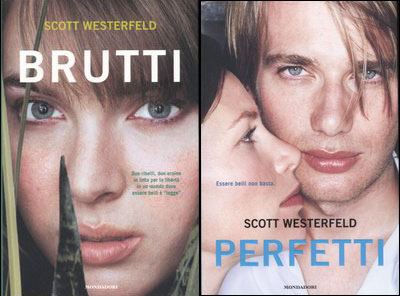
Italian Uglies Covers

As I blogged earlier, the Italian cover for Uglies uses the same photo as the American, but flipped and with more of the model’s face on the front. But the cover for Pretties is totally different, and yet mysteriously the same.

And it’s just so . . . ciao.

Know what I mean?

But I love the translation of the title: “spotless ones,” “flawless ones.” Or, to follow the series style more closely, “perfects.”

UPDATE The tagline, Essere belli non basta, has been generally translated as “Being beautiful isn’t enough.”

German Uglies

Okay, you’ve had to sit through me getting my cranky on in my last post. So here’s something much more happy-making:

Yes, it’s the German covers of the Uglies trilogy.

In a funny way, these are the most “realistic” of the covers for the trilogy. The model for Ugly looks like a real girl. Her skin is a bit freckly, her eyes a bit small. Not that she isn’t pretty, but she’s definitely not a pretty.

But the image for Pretty is almost freakish. As I’ve often said, if we saw a pretty here in our world, we’d probably find them a bit weird and exaggerated. Plastic sugery arms races tend to go in strange directions, after all. (Warning: Following that link risks severe eyeball damage.)

And Special is the best of all. It takes the exact same face and makes it totally mean. Sort of like a Chucky doll with tattoos.

Casting your eyes over all three faces, you see the subtle change in expression that mirror Tally’s journey, from curious ugly to vacant pretty to imperious, cruel Special. How cool is that?

Big props to the designers over at Carlsen, the German publishers of Uglies.

By the way, does anyone know a German-language reason why the titles are singular?

Alternate Worlds

It’s been a while since I’ve ranted against a major paper for misconstruing genre, so let’s dust off the old soapbox. And, yes, I’m going to be mean.

Here’s an outrageous bit of genre-subliterate hooey from the Guardian:

Michael Chabon’s new novel is a brilliantly written fantasy with a not-quite-fatal flaw at its heart . . . .

The real problem with the book is the piecemeal way Chabon introduces his alternate reality. It’s an unwritten rule of the genre (well, it’s written now) that you should be able to define the difference between the parallel world and ours in a single sentence. Armada triumphs, Elizabeth assassinated (Keith Roberts’s Pavane). Axis powers defeat the Allies (Dick’s The Man in the High Castle). Lindbergh becomes President (Roth’s The Plot Against America). No such establishment of a baseline is possible with The Yiddish Policemen’s Union.”

Argh. You mean the genre of alternate worlds has been allowed to evolve past the rulebook of the English Amateur Historians’ Counterfactual Society? Heavens forefend!

That’s right, young readers. About a million years ago, writing alternate history meant you could only change one thing: Confederacy wins, Ghandi hit by train, cheese not invented. And it was the singularity of this shift that proved how clever you were, by showing how many dinosaurs you could kill by stepping on one butterfly.

And yes, that’s still a perfectly glorious thing to do. But to assert that any book not hewing to this rule must be “flawed” is super-lame. Plus it means you probably haven’t read as many comic books as, say, Michael Frickin’ Chabon!

The writer of this article, Adam Mars-Jones, goes on to state that he can think of only a single exception to this “unwritten” rule, Nabokov’s Ada. I will allow commenters to come up with a burying horde of examples. (Though I will mention that in Pavane rail trains are never invented, surely not as a result of a victorious Armada, so Mars-Jones’ own examples fall apart. Nyah.)

However, as I’m currently editing an anthology of essays about Phillip Pullman, let me rant specifically on His Dark Materials. In Pullman’s world:

1) The Reformation never happened. (There’s a Pope Calvin!)
2) Texas is a nation. (Possibly Reformation related?)
3) Victorian arctic pseudo-sciences all turned out to have a basis in reality. (Yes!)
4) People have externalized souls, polar bears can talk, plus witches.
5) Many, many other things.

Okay, so maybe that number 4 is the key to Mars-Jones’ thinking. HDM is all magicky, so maybe it doesn’t fall into some weirdly strict Mars-Jonesian category of counter-factual.*

Yes, in many magicky books like Narnia, lots of things are different: beavers talk, White Queen dominates, Jesus is a lion. But whatever they symbolize, such worlds aren’t “alterations” of ours, and Pullman’s world is. HDM has an Oxford, a London, a Texas, Zeppelins, and telephones. (Note to Guardian editors: The presence of Zeppelins categorically indicates alternate history. Look it up.) And the fact that in Pullman’s world there are more alternate worlds, of which Lyra’s is one, more or less seals the deal.

I’m sure the younger readers of this blog will be mystified that anyone would even make a proclamation like Mars-Jones’. An average-size shelf of manga contain a thousand worlds with ten zillion alterations, picked and chosen from a million columns. (I still have no idea what the Catholic Church is supposed to be in Helsing, but it’s awesome.) This is what sf and fantasy have become: every world is a reworking of an alteration of a speculation. And that’s a good thing.

To suggest otherwise in one of my favorite papers is unacceptable. And worse . . . it means yer old and stuffy.** Nyah again.

I’m just glad I live in this world, the one where the world-alterers won.

__________________________

*The term that airship pilots use for “alternate history.”
**Told you I would be mean.

BEA Swaglist

There were many requests in the comment thread of my last post to list the titles and authors of my swag. Okay, I’m listing them. But remember, they’re mine, all mine! Bwah-hah, etc.

Plus, most of these books don’t come out till autumn.

And for a screen-filling, monster-huge version of this photo, click here.

TOP ROW FROM LEFT

The Penalty by Mal Peet
YA set in Brazil, about a soccer prodigy. I’ve heard good things about Peet.

13 Bullets by David Wellington
Splatterpunk vampire novel, by the author of the online zombie apocalypse novel Monster Island, which was cool.

Shinjuku Shark by Arimasa Osawa
Hardboiled detective in Tokyo. Adult themes!

The World Without Us by Alan Weisman
Non-fic about what would happen to Earth if all humans disappeared instantly right now. Like, how long it would take everything to go back to a pre-technology state. I am so reading this, if only so my next zombie apocalypse novel has good science.

Poseur by Rachel Maude
Three girls start their own fashion label. A very pink book.

Zugzwang by Ronan Bennet
A chess thriller (?) set in 1914. That’s the same time period as Leviathan, so it’s a must-read for me.

The Scandal of the Season by Sophie Gee
An affair in 1711 London, by an Aussie writer who Justine adores. And yes, nice cover.

I repeat the swag photo, for ease of use. (And again, for a screen-filling, monster-huge version of this photo, click here.)

MIDDLE ROW FROM LEFT

Deadline by Chris Crutcher
A teen has one year to live. Crutcher rocks.

Foundling by D.M. Cornish
Lavishly illustrated Book 1 of Monster Blood Tattoo series.

The Asbolutely True Diary of a Part-Time Indian by Sherman Alexie
YA about a Native-American teen who wants to become a writer.

Betwixt by Tara Bray Smith
YA supernatural about kids with gnarly powers.

Boy Toy by Barry Lyga
By the guy who wrote The Amazing Adventures of Fanboy and Gothgirl, so should be really good.

Electric Church by Jeff Somers
Hardboiled cyberpunk.

Grub by Elise Blackwell
A parody of the publishing world. Can’t wait.

I repeat the swag photo, for ease of use. (And again, for a screen-filling, monster-huge version of this photo, click here.)

BOTTOM ROW FROM LEFT

Little (Grrl) Lost by Charles De Lint
Small visitor in 14-year-old girl’s life. Love De Lint.

Shojo Beat 3
A manga compilation.

Shonen Jump 2007
Another manga compilation.

Chibi Vampire by Yuna Kagesaki
Vampire manga!

Chain Mail by Hiroshi Ishikazi
See previous post.

Avalon High by Meg Cabot
A working document of the upcoming manga version of her series. It starts out in real art, changes to pencil sketches, then is just a rough script. Kewl object to own.

Apollo’s Song by Osamu Tezuka
Manga from the Astro Boy dude.

Boy by Takeshi Kitano
Lit fic by the guy who made the film Hana-bi.

BEA Swag/First Page Test

So on Halloween night when you get home, do you ever take a picture of the collected swag? Or at least dump it on the bed and ogle?

Well I don’t Trick or Treat much anymore, but here’s (most of) my BEA swag, all organized by size.

Mmm . . . free books.

When buying books, I usually avoid the back cover (spoilers!) and go straight for the first-page test. Judging a 80,000-word document on the basis of one page may seem cruel and unusual, but I’ve found that most books reveal a lot about themselves in that first minute. At least, they reveal more than real-live human beings when you first meet them. A human, after all, might just be having a bad day.

So here’s a quick BEA-swag-related First Page Test for your delectation.

Chain Mail, by Hiroshi Ishikazi (Tokyopop)
(fourth from right, bottom row)

I stood in front of the mailbox and cried. Snow fell around me, frosting my hair and shoes, slowly blotting out the words of the test results I held in my hands. Out of over twenty-five thousand test-takers, I had placed first in Japanese, Mathematics, Science, Basic Studies, and General Studies. I had finally made it.

But it was too late. My mother was gone, and she wasn’t coming back. If I had only studied harder, if I had only gotten these results a month earlier, maybe it would have made a difference.

Melting snow slid down my back. I shivered, remembering the sound of flesh striking flesh . . .

Things that brought me in:

1) “I stood in front of the mailbox and cried” is a lovely first sentence. We are somewhere specific, and something specific is happening.

2) I like “frosting” a lot, because it’s being used in a slightly unusual way, and is strong visually. And there’s something perfect about the snow alighting specifically on the character’s “hair and shoes.” Hair, because it reveals that she’s not wearing a hat—she just stepped out to grab the eagerly awaited mail. And shoes, because she’s looking down at the letter, and also because she’s crying—staring at your shoes is not usually a sign of happiness. (I’m assuming the protag’s a girl because of the cover, by the way.)

3) Wait, she’s crying because the test results are perfect? Brain was ready for the opposite. Unexpected is good.

4) The second paragraph sets off a wave of micro-mysteries for the reader. How did her test results make her mother go away? And is her mother dead, or something else?

5) “Melting snow slid down my back. I shivered, remembering . . . ” is a cool way to physicalize the bad memory. And “flesh striking flesh” is definitely bad, bad, bad.

Things that kicked me out:

1) The construction “test-takers” is clunky to me. Like, why not say “students”? I mean, we know this is about testing. You could just say “Out of twenty-five thousand, I had placed first” and it would make sense. Still, the term is probably just a literal move from the more elegant Japanese. Translations get a few extras free passes, because I like the odd feel of an ocassional literalness.

2) Maybe we’re going a little too quickly into the explanation of this little micro-mystery? I’m not a fan of flashbacks that start before we’re fully in a scene, which always seems stagey.

These are minor quibbles, though. I’d definitely keep going.

I’ll be doing more of these soon. It’s a fun and easy way to dispense writing advice. But I won’t be doing any American authors, for reasons that I will soon reveal.

And in fairness, I’ll be putting up my own first page soon . . . Extras‘, that is. So you can mock it to your hearts’ content.