John Scalzi and I have been warring for the last few months (seems like years) over the subject of whether Pluto is a planet or not.
Of course, it is not. Even the Pluto-sympathetic IAU, which is meeting this month to discuss such matters, will probably politely demote it to “dwarf planet,” “ice dwarf,” or some other humiliating category.
But in his slavish devotion to schoolchild memorization exercises, Scalzi will not give up the fight. Now he’s even impressed his charming daughter into the doomed struggle.
Watch in awe as Cthulhu eats me, Scott Westerfeld, in effigy.
Okay, I’ve avoided the subject on this blog, because it’s Last Days Month, after all. But enough is enough! Because when in the course of human events it becomes necessary for one heavenly body to dissolve the astronomical bands which have connected it with another and to assume among the powers of the solar system the separate and superior station of “planet” to which the Laws of Nature entitle them, and to demote the other to the station of “ice dwarf,” a decent respect to the opinions of humankind requires that the inhabitants should declare the causes which impel them to the separation. So . . .
WHY PLUTO IS NOT A PLANET
Position
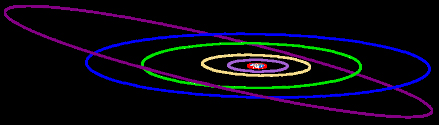
Hey, look! One of these things is not like the others. That’s right, the purple one. It’s all over the place: inside Neptune’s orbit one decade and then outside the next; topsy-turvy and crooked. Or as an astronomer might say, “Several orders of magnitude more elliptic and eccentric than the eight real planets.”
By the way, that red splodge in the middle is the four terrestrial planets: Mercury, Venus, Earth, and Mars.
And see how neat the eight real planets are? Why are they all in a plane like that? Because they all formed from the same disk of material (known as “the accretion disk”) and are therefore all cousins. They are related.
Pluto is just a crappy piece of leftover, non-accretion-disk ice. Which brings us to . . .
Composition
Pluto’s exact composition is not known, but a third to a half of the dwarf is almost certainly composed of ice. That’s right, it’s almost equal parts rocks and water, and we have a name for rock + water objects in space: comets.
Pluto is compositionally a comet. And that’s why its orbit is incredibly eccentric. A little more eccentric, and it would be lighting up our skies as it melted away, and would be called “Tombaugh’s Comet” or something like that.
History
Now here’s where the Plutophants always get nostalgic. They think that the millions of plastic Denny’s placemats printed over the last 70 years that call Pluto a planet somehow legitimate the term. Pluto should be “grandfathered” in, or maybe we should make a special name like “minor planets” for Pluto and its numerous Kuiper Belt pals.
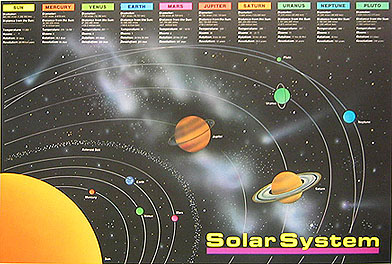
Image courtesy of Northwest Nature Shop. Get them while they still make ’em.
But here’s the problem with that, Plutophants: we’ve been down this road before. And your side LOST!
In 1801, Guiseppe Piazzi discovered a new “planet” called Ceres Ferdinandea. The lame last name was soon dropped, but otherwise everyone was thrilled and excited. Then a second “planet” was spotted in Ceres’ orbit, called Pallas. Then two more: Juno and Vesta.
Now, some folks immediately suggested downgrading Ceres and its buddies to non-planets, and suggested the term “asteroids.” But the Ceres-lovers refused, because planets are wonderful and pretty and Denny’s had already printed up some lovely placemats!
In 1828, a book called First Steps to Astronomy and Geography listed the planets as, “Eleven: Mercury, Venus, the Earth, Mars, Vesta, Juno, Ceres, Pallas, Jupiter, Saturn, and Herschel.” (Herschel is the old name for Uranus, changed to facilitate the snickering of generations of schoolkids.)
That’s right, we had eleven planets, and that was before Neptune or Pluto hit the scene.
From 1845 to 1851, 11 more “planets” were discovered in Ceres’ orbit. It was pretty clear to everyone that things had gotten out of hand. But the always optimistic planet-o-philes didn’t want to outright demote anyone, because that would be mean.
So they came up with the lame idea of “minor planets.”
In 1866, the Paris Observatory first used the description “petites planets” to describe the ever-more-numerous asteroids. Tellingly, Ceres, Pallas, Juno, and Vesta were “grandfathered” into the ranks of full planets at first. (I didn’t know they had Denny’s in Paris back then.)
The U.S. Naval Observatory went psycho for a few decades, using the word “asteroids” until 1868, then switching to “small planets,” then back to “asteroid” in 1892, then to “minor planets” in 1900, and at long last to “asteroids” in 1929, only a year before Pluto was discovered.
Phew. Close call there.
Other organizations used various wordings, but by the beginning of the twentieth century, the Denny’s-eating, planet-loving lobby had been largely defeated.
This, my friends, is exactly what will happen to Pluto. Yes, the IAU may come up with “minor planet” or “dwarf planet” or some such drivel, but as new discoveries mount, and the list of “planets” get longer and longer and more and more embarrassing, we’ll slowly stop using that word. And by the way, we’re not talking about mere dozens of planets here; some estimates put the number of significant Kuiper Belt objects in the tens of thousands. But long before we find that many, we’ll be calling Pluto what it is:
The King of the Kuiper Belt!
Which brings me to my final point . . .
Common Decency
Why would Pluto want to be a planet?
As a planet, it’s a tiny little, out-of-whack runt! As a Kuiper Belt Object, it’s a rocking big heavyweight bruiser. Okay, not quite as big as UB313, but it’s got more moons!
So as a matter of common decency, we should realize that Pluto would rather rule in the icy reaches of the Kuiper Belt than be subject to mockery in the warm glowing warmth of the inner solar system. It’s named after the god of the underworld, after all.
But the Cthulhu doll was cute.
For even more detail on the “minor planets” of the nineteenth century, written by people who (unlike Scalzi and me) actually know things, check here.