Slanguage

Those of you who follow Justine’s blog have already seen this, but I had to use it too. It captures Justine and I during our SCBWI appearance in Bologna.

Philip Stanton is an illustrator, and takes his notes in sketch format. For some reason, I love the arrow pointing to me that says, “From Texas.”

But, yo, my nose isn’t really that big. I’m just saying.

Another intriguing bit of student work from Bologna are these notes about my “slanguage” presentation. I was talking about teen vernacular and slang and language in general, and Candy manages to make me sound coherent.

Maybe from now I’ll just rant and have people write it down. It would be way cool if that worked with novels . . .

Cool Stuff

First among cool stuff is the fact that Justine has been boingled!

Click here to witness said boingling. (And here for Justine’s response.)

I really like Cory’s capsule reviews. They always elucidate plot and theme from an interesting angle (as seen here in his review of Midnighters). He’s an adult sf author, but it seems the new wave of cool YAs has started to draw him over to the dark side. Also, he knows the value of the pull-quote: “Magic or Madness . . . has everything it takes to be an instant classic for smart, curious kids who look to fantasy for more than escape—who look to fantasy literature to stretch their understanding of the real world.” Sweet.

And here’s few other newly learnt cool things that I forgot to mention in my post about Bologna:

1. The words “So Yesterday” translate perfectly into Finnish.
2. The phrase makes no sense in French, and the book’s publishers in France, Editions du Panama, don’t know what to call their edition yet.
3. “So Yesterday” also makes no sense in Swedish, so that edition will be called:

So what the heck does “Ute/Inne” mean? Pretty much what it sounds like if you say it in a mock Swedish accent: “out/in.” In other words, “what’s hot/what’s not,” except backwards.

Reading the tagline, “en roman av Scott Westerfeld,” I started wondering why roman means “novel” in so many Indo-European languages (including English, in loan-phrases like roman-a-clef). It was also bugging me in Bologna, where the word was all over the place; in French, Italian, Spanish, Portuguese, and Russian, novels are called romans or some such word.

I decided to go poking around in the OED, and in retrospect the answer seems pretty obvious. The earliest uses of the term applied to “romances”—long romantic poems, that is—the precursors to the modern novel.

So if anyone ever disses you for reading a romance novel, you can always point out that all novels were romances originally. So chew on that.

Bologna Rox

Ciao! Just got home from Italy, home of the Bologna Children’s Book Fair!

First, the travel report: Our one-hour flight from Bologna to Frankfurt took many hours, because the first flight was cancelled and the second an hour late. This left us with 15 minutes to sprint across Frankfurt airport and catch the plane to Singapore. We were so late that we’d lost our seats, and had to be seated apart for 12 hours, me in a dreaded middle seat of the dreaded middle row. In Singapore Airport we got a micro-hotel room for a shower and two hours of precious horizontality. Then seven hours to Sydney.

It was a long day—actually two days, because of the time shifts. (If I owe you email, or haven’t posted in other comment threads, forgive.)

But enough complaining. The main thing to know is that Bologna is gorgeous . . .


Bonfiglioli Images

And old. It has Roman walls around its center, but it’s the medieval buildings that rock most. In the 1200s, the city’s wealthy families competed with each other by building big towers. (To like, uh, show that they were wealthy. That was before TV.) The two most famous are above.

Bologna also has the best food evah. Blood orange juice, lots of truffles (not the chocolate kind; the mushroomy kind), and, of course, genuine SpagBol. (Which means “Spaghetti Bolognaise.” Did you guys know that? Turns out my German translator didn’t . . . Oops.)

We ate at this one place where they pour hot risotto into a giant hollowed-out wheel of parmiagiana, stirring it around so that it sucks up the cheesey goodness, and then shave truffles on top. They also put truffles on fresh mozzerella, on eggs, and on potatoes. Death by truffles.

We ate there twice. (Thanks, Eloise!)

The book fair itself was amazing. About 8,000 illustrators, editors, agents, sub-agents, scouts, and other publishing types were gathered to talk books, make deals, and decide what’s hot. As authors, Justine’s and my job was like that of lobsters in a restaurant tank: look pretty at dinner. Now, this simile has issues, given that we were wanting to be chosen, and the lobsters maybe not so much. But you get it, right? Basically, we were there to put a human face on our books, to be charming, and to let our agents and US publishers drum up interest in other lands and languages.

It was a great week. I love hanging out with book people, who are smart and dedicated and interested in the world. Surrounded by 8,000 experts, these are the things I learned about children publishing:

The history, economics, and mechanics of pop-up books is endlessly fascinating.
Sweden likes hardbacks; Brazil prefers trade paperbacks.
Translators in France earn 8-10 cents per word (US cents), plus 1% royalties.
The children’s picture book market tanked about ten years ago.
Scouts are like reverse agents: matchmakers, but paid by publishers instead of authors.
Gossip Girl is published in 29 territories.
The Italian kids/YA market is 75% books in translation.
The Dutch throw the best parties.

Okay, I haven’t even mention the SCBWI conference we taught at, or the amazing fig gelato, or that our luggage is still in Frankfurt. But jetlag is eating my brain now. Must watch mindless TV.

Luckily, Justine has put up a rather more coherent post than mine.

So let me just say thanks to everyone who bought us dinner, lunch, or drinks, or just told us cool stuff.

Magic Lessons

News Flash! My first ever book-jacket photography credit appears in stores today!

Allow me to explain:

Exactly a year ago, my lovely wife Justine’s book Magic or Madness came out. In that year it has received mountains of rapturous praise. In fact, before I go on with the story, let me be a proud spouse and share my favorites blurbs with you:

“Larbalestier has wrought beautiful and fearsome magic in this novel . . . this radiant gem stands alone, but expect readers to be impatient for the rest of the trilogy.”
—School Library Journal

“In this fierce, hypnotic novel, character, story, and the thrumming forces of magic strike a rare, memorable balance.”
—Booklist

“A vivid and uncompromising portrayal of magic and the consequences of power.”
—Holly Black

Wonderful stuff. And even better, it comes out today in paperback and can thus be bought for a pittance.

But that’s not the point of my story, which is about me.

You see, my photo credit is in Justine’s second book, Magic Lessons, which also comes out today. Here’s how it all happened:

Justine was asked by our publisher for ideas about the cover. There’s this scene set in a wonderful and strange cemetery, one that really exists in Sydney. We tried to describe its crooked, broken headstones and giant Moreton Bay fig trees to the designer, but he couldn’t grasp what we were talking about. For one thing, he had never seen a proper Aussie fig tree before.

So we went down to the cemetery and took a bunch of pictures. Little did we know, they would wind up using our actual pictures! We rule.

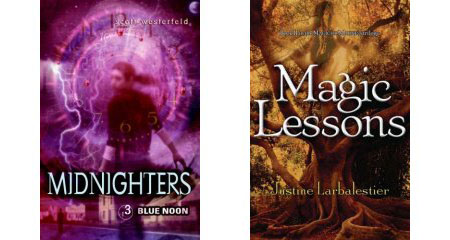
One of Justine’s lovely tree photos is on the cover, and my headstone shots adorn the back. Here are the two books together:

Beautimous, eh? Here’s all the pictures we took in their raw form. (As you can see, it really is the most awesome cemetery.)

To read more about Justine’s series, go here!

Uglies in the NY Times

Naomi Wolf has an article in the NY Times today, in which she disses the heck out of Gossip Girl and its spin-offs. Also, Uglies gets a positive mention (see below).

She starts by warning parents:

They carry no rating or recommended age range on the cover, but their intended audience—teenage girls—can’t be in doubt. They feature sleek, conventionally beautiful girls lounging, getting in or out of limos, laughing and striking poses. Any parent—including me—might put them in the Barnes & Noble basket without a second glance. Yet if that parent opened one, he or she might be in for a surprise.

Oooh, scary. But one question: Does anyone buy books “without a second glance”? Really?

And another: Is Naomi Wolf calling for parental advisory labels on books? I hope not. Probably this is more of a “hook” than an argument. It’s like when the local TV news says, “Some scientists think that this common household cleaning product can kill you! Details at eleven.”

Because teen culture is just like chemicals: to comprehend it you have to be some sort of gnarly expert. And it’s dangerous! Terribly dangerous! So I’m sure there are people out there who do want warning labels. Reading stickers is easier than, you know, talking to your kids about what they’re reading.

What Wolf is really obsessed about it the lack of judgement these books take against their shallow, vain characters. She says they’re “like Lord of the Flies, set in the local mall, without the moral revulsion”? And it’s true—there is no moral revulsion on the page in GG. There’s ironic detachment, but you have to bring your own revulsion.

But you know what? My guess is that teens do bring their own value system to these books. No doubt some read them in a totally shallow way: “I wish that was me all beautiful, dripping with Prada and ruining some other girl’s life.” But I know for a fact that others read them as satire, as an attack on the shallowness they portray. And some read them simply as a tacky pleasure. (I sort of like excessively self-centered characters, just like I sometimes enjoy excessively top-loaded ice-cream sundaes.)

I’ve only read one GG, and I liked it that there’s a bulemic character, but without bulemia being the central arc. It’s just something that happens, something unpleasant, but not The Plot. (Sort of like having a character in a wheelchair, but being in a wheelchair isn’t the whole friggin’ point of the book.)

GG did bore me with its relentless brand names. (Stephen King does too.) My eyes bleed when books employ brand names instead of adjectives and dramatic exposition. But this isn’t a moral failure; it’s an artistic one. You can read brand-name overload as satire, wish-fulfillment, or product placement.

So instead of worrying about the lack of moral instruction in GG, maybe parents should focus on knowing what kind of people their kids are—the subversive kind, the kind who like a good trashy read, or the kind obsessed with status. And instead of warning that YA packaging doesn’t give adequate parenting info, maybe Wolf should encourage parents to talk about books with their kids. (Strangely, this suggestion never comes up in her article. Not once.)

The Good News

Of course, we all know that my books are chock full of moral-icious goodness. And to prove it, there’s a sidebar to Wolf’s article that lists eleven decent and uplifting books. Uglies is the very last one. (Damn you, alphabetical order!)

So I’m curious. How many of you guys have read the Gossip Girl and A-List, Clique books? And what do you think they did to your moral fiber? And how many of your parents talk to you about what you’re reading?

Octavia E. Butler

I have much news to report, most of it good. But before I do, this piece of bad news needs its own entry.

SF writer Octavia Butler died this weekend at the age of 58. Way, way too young.

My first encounter with Butler was a novel called Wild Seed, and the experience still resonates in my head. The villian of the book, Doro, is a sort of psychic parasite who has lived for thousands of years in various hosts. He’s one of the most convincing immortals, most brutal characters, and most seductive antagonists I’ve ever read. He inflects every super-powered character I’ve ever written.

Butler won Hugos and Nebulas, and was the first sf writer to be awarded a MacArthur “Genius” Grant. But I don’t think many in the field ever realized how transformative she was. Her focus on biology took a lot of what had happened to sf in the late 1960s and early 70s with regard to politics and gender, and turned it into something harder, in the scientific sense, and edgier in every other sense.

Whenever people run that line about the period “before cyberpunk” being fallow and tame, I shake my head and realize how much farther we have to go. When Butler wrote about the effects of misused power on individuals, she blew those boys out of the water on every single page. She could be truly scary, in a way that splendidly illuminated this truly scary world.

She will be sorely missed.

Two years ago, Butler published a story on scifiction. It’s not her best work by a long shot, but it makes for eerie reading at the moment. It’s an auto-biographical meditation on what it is to be a science fiction writer: what it means to create worlds and to map the future of humanity—to play god, in other words. But it’s bigger than that. It’s about what we as a species need to be thinking about right now.

It begins with these words:
“It’s difficult, isn’t it?” God said with a weary smile. “You’re truly free for the first time. What could be more difficult than that?”

You can read it here.

World Tour!

Justine and I are only three weeks away to heading off on what we’ve been calling the “round-the-world jaunt that ate March.” This trip may kill us, but for those of you who live in Brisbane, San Francisco, NYC, or Bologna, it will mean a chance to say hi and get books signed.

Here’s our appearance schedule, starting with a trip up the east coast of Australia:

Saturday 25 February 2006
Aurealis Awards Ceremony
Brisbane, Qld

First a short hop up to Bris-Vegas for the Aurealis Award Ceremony. We’re both up for best Young Adult SF or Fantasy novel of 2005! Me for Uglies and Peeps, Justine for Magic or Madness. (I hope she wins, so I don’t have to make a speech.)

A little more than a week later, we fly across the Big Pond to California. We’ll be staying with friends, doing an interview with Locus Magazine, and doing two appearances:

Tuesday 7 March 2006, 7PM
Borderland Books
866 Valencia St
San Francisco, California

I’ll be sitting next to a big stack of Midnighters 3: Blue Noon and Justine will be signing her sequel, Magic Lessons.

And the very next night, doing the same thing, except here:

Wednesday 8 March 2006, 6PM
Books Inc.
Laurel Village
3515 California St
San Francisco

Then it’s off to New York for two weeks of hanging out with friends and making sure the NYC apartment hasn’t burned down, exploded, or become infested with parasites of some kind. For those of you within spitting distance of Manhattah, there’s one public appearance (so far):

Saturday 18 March 2006, 12-2PM
Books of Wonder
18 W 18th Street
New York City

But you aren’t allowed to actually spit on us. It’s just a figure of speech.

Finally in late March, we fly over to Italy for two things in Bologna:

25-26 March, 2006
SCBWI Before Bologna Conference

SCBWI is the Society for Children’s Book Writers and Illustrators. Justine and I are teaching three workshops together about writing for kids. One about synopses, one about slang, and one about regional voices. (Hey, if you want to enroll, it’s cheaper if you do it before February 15.)

And then the Fair itself starts:

27-30 March, 2006
Bologna Children’s Book Fair
Bologna Fair Centre – Piazza Costituzione Entrance

This is an annual event where pretty much every publisher in the young readers’ world comes together to schmooze, eat, drink, schmooze, and buy foreign rights. Justine and I will get to meet all the cool people who’ve translated our works into Italian, German, Japanese, Thai, Swedish, Chinese, Polish, Russian, Finnish, Hebrew, Spanish, and Slovene*. It promises to be full of multi-lingual conversations and good meals, because you can’t beat Italian cities with food named after them. (And that’s no baloney. Hah! . . . sort of.)

And at last there’s the mega-flight from Bologna, to Frankfurt, to Singapore, to Sydney. Followed by sweet, sweet death. (By which I mean, of course, sleep.)

*By the way, did I mention that So Yesterday sold in Slovene? You know, the language of Slovenia. The country Slovenia, next to Italy and stuff . . . Hey, Slovene is the new black, dude.

Peeps Is Unshelved

How kewl is this?

Unshelved a daily comic strip set in a library, which every Sunday becomes a book review in comic form. This is a fantastic idea, on top of which, Peeps is their book of the week! Color me very pleased.

Check it out:

Ah, if only they’d spelled my name right. But you can’t have everything.

For the full-size version, and the rest of this excellent strip, (and to see my name spelled right! thanks guys), go here.

I will take this opportunity to tell you all that Peeps has been on a winning streak lately:

Top Ten Book for the 2006 ALA Best Books YA Awards

Top 40 Children’s Books for 2005 in Kirkus Reviews

Best Books of the Year in 2005 in School Library Journal
(Justine’s Magic or Madness is on there too!)

Awarded a 2005 Blue Ribbon by the Bulletin of the Center for Children’s Books

Locus Recommended Reading List for 2005.
(Again! Magic or Madness is there in First Novels!)

Cool, huh? So thanks to all the librarians, reviewers, and editors out there who slave to read dozens (even hundreds) of books every year and then bother to write them up. Without you, us readers wouldn’t find nearly as much of the cool stuff there is to read.

And us writers? Well, we’d just starve.

(Feeling an impulse purchase coming on? Just click here. Or here!)

PS Thanks to John, Joe, and Kendall for alerting me to the Unshelved strip.

“King of the Cool Codes”

Those are not my words, but the headline writer of The Melbourne Age, the biggest newspaper in Australia’s second biggest city. Eep. A bit blush-making.

The article, by the excellent Mike Shuttleworth of the Centre for Youth Literature, is a result of So Yesterday winning the Victorian Premier’s Award down there. It’s a great big article in the A section, with a big-ole photo of me in my, ahem, coolest T-shirt:


Jennifer Soo

Yes, that’s me looking off into the future of literature. Or maybe flexing my imagination, or thinking, “Hope I don’t look like a wanker.”

I’m always exceedingly nervous about any picture of me appearing that I don’t have TOTAL control over. Not to mention articles that quote me rattling along before breakfast on many cups of coffee. But Mike managed to make me sound smart, and Jennifer made me look (passably) cool. Much thanks to them both.

Here’s the article.

For a password, go to Bug Me Not. (If you’re already a Sydney Morning Herald reader, you don’t need one.)

And it starts:

Scott Westerfeld describes his lifestyle as “bi-summeral”. For the past five years, the laconic, softly spoken Texan has moved between Sydney and New York with his partner, Australian Justine Larbalestier (herself a young-adult fiction writer). They met at the Nebula Awards in New York in 2000 (“How geeky is that?” he asks) and now they divide their time between apartments in Manhattan and Surry Hills.

Westerfeld is a writer of young adult fiction, living the perfect life for exploring the teenage cool world. He is the author of more than a dozen books, including So Yesterday, a whip-smart thriller about a New York trend-spotter and a culture-jamming scam . . .

All very blush-making.

Writing Advice 3

While I was finishing Specials my fictional brain started to break, so I decided to take some time off from narrative. Fortunately, a collection of letters written by the great hard-boiled writer Raymond Chandler leapt from the depths of my Sydney storage unit and into my hands.

Chandler’s technique for writing letters was to stay up at night drinking and talking into a tape recorder (a wire recorder in those days, actually). The next day his secretary would type up his rantings and send them in the mail. This led to many a drunken tongue-lashing, and a fair amount of solid writing advice, being preserved for posterity.

As I re-read the letters, I realized that I’ve stolen a lot of Chandler’s writing techniques over the years, especially his “four-hour rule” (see below), which I’ve expounded to many a writing class. So I figured it was time to ‘fess up and show all of you the source material.

So here is the unalloyed Raymond Chandler on the subject of writing:

1. Letter to Frederick Lewis Allen, editor of Harper’s Magazine
7 May 1948
My theory was that [the readers] just thought they cared about . . . the action; that really, although they didn’t know it, they cared very little about the action. The things that they really cared about, and that I cared about, were the creation of emotion through dialogue and description; the things they remembered, that haunted them, were not for example that a man got killed, but that in the moment of death he was trying to pick a paper clip up off the polished surface of a desk, and it kept slipping away from him, so that there was a look of strain of his face and his mouth was half opened in a kind of tormented grin, and the last thing in the world he thought about was death. He didn’t even hear death knock at the door. That damn paper clip kept slipping away from his fingers and he just wouldn’t push it to the edge of the desk and catch it as it fell.

That paper clip image is very goosepimple-making, a classic noir example of the crumpled little guy facing oblivion. Of course, we all know that a guy trying to pick up a paper clip on a hoverboard would be cooler. And like, especially if the paper clip exploded . . .

This next motivational technique is one I always tell aspiring writers to try:

2. Letter to Alex Barris, an interview by mail
18 March 1949
The important thing is that there should be a space of time, say four hours a day at least, when a professional writer doesn’t do anything else but write. He doesn’t have to write, and if he doesn’t feel like it, he shouldn’t try. He can look out of the window or stand on his head or writhe on the floor. But he is not to do any other positive thing, not read, write letters, glance at magazines, or write checks. Write or nothing. It’s the same principle as keeping order in a school. If you make the pupils behave, they will learn something just to keep from being bored. I find it works. Two very simple rules, a. you don’t have to write. B. you can’t do anything else. The rest comes of itself.

Put those two rules on your refrigerator and you’ll have a novel within a year. Or at least someone else who uses your refrigerator will.

The letter below reminds me of something Kingsley Amis said: “Sometimes the hardest part of writing is getting the characters out of the pub and into the cab.” Writers don’t just get stuck at the earth-shattering, life-changing decisions that our characters make; the little details of reality management are actually quite tricky and frustrating. Never assume you’re a crap writer just because you can’t get someone across a room—it happens to all of us.

3. Letter to Paul Brooks, a publisher working on a Chandler collection
19 July 1949
When I started out to write fiction I had the great disadvantage of having absolutely no talent for it. I couldn’t get the characters in and out of rooms. They lost their hats and so did I. If more than two people were on scene I couldn’t keep one of them alive. Give me two people snotting at each other across a desk and I am happy. A crowded canvas just bewilders me.

This letter to Alfred Hitchcock contains fantastic advice for writers as well as film-makers. Just substitute the words “wicked-cool sentence” or “scintillating simile” for “camera shot.”

4. 6 December 1950
As a friend and well-wisher, I urge you just once in your long and distinguished career . . . to get a sound and sinewy story into the script and sacrifice no part of its soundness for an interesting camera shot. Sacrifice a camera shot if necessary. There will always be another camera shot just as good. There is never another motivation just as good.

Beyond his anti-Agatha Christie snark, there is an excellent point below about the difference between novels and short stories. A lot of writers who excel at the story level don’t think to “turn the corner” when attempting the longer form.

5. Letter to Dorothy Gardner, secretary of the Mystery Writers Association
January 1956
The trouble with most English mystery writers, however well known in their world, is that they can’t turn a corner. About halfway through a book they start fooling with alibis, analyzing bits and pieces of evidence and so on. The story dies on them. Any book which is any good has to turn the corner. You get to the point where everything implicit in the original situation has been developed or explored, and then a new element has to introduced which is not implied from the beginning but which is seen to be part of the situation when it shows up.

Speaking of snark . . . bet you didn’t know that Raymond Chandler’s brief foray into science fiction actually predicted the rise of Google as an information search service. Check this out:

6. Letter to H.N Swanson
14 March 1953
Did you ever read what they call Science Fiction? It’s a scream. It’s written like this: “I checked out with K19 on Abadabaran III, and stepped out through the crummaliote hatch on my 22 Model Sirus Hardtop. I cocked the timejector in secondary and waded through the bright blue manda grass. My breath froze into pink pretzels. I flicked on the heat bars and the Bryllis ran swiftly on five legs using their other two to send out crylon vibrations. The pressure was almost unbearable, but I caught the range on my wrist computer through the transparent cysicites. I pressed the trigger. The thin violet glow was icecold against the rust-colored mountains. The Bryllis shrank to half an inch long and I worked fast stepping on them with the poltex. But it wasn’t enough. The sudden brightness swung me around and the Fourth Moon had already risen. I had exactly four seconds to hot up the disintegrator and Google had told me it wasn’t enough. He was right.”
They pay brisk money for this crap?

Yes, Mr. Chandler, they do.

You can buy the collection, edited by Tom Hiney and Frank MacShane, right here.