Back in Sydney

I haven’t been posting as much lately. But as you probably have noticed, Justine and I have been in Istanbul the last week or so, me doing research for the next book in the Leviathan series, and her mostly eating.

We also got to meet with some of our Turkish publishers: Epsilon, who will bring out Leviathan next year; and Artemis, who publish the Midnighters books and will soon be releasing Justine’s latest, Liar. We didn’t get to meet with Tudum, who publish the Uglies series (which apparently tanked in Turkey). But thanks to everyone for their tremendous hospitality.

Here are the Turkish covers for the first two Midnighters books:

turkishmidnighters

Kind of a goth/gypsy vibe going on here. From what my editor at Artemis said, the books didn’t sell well at first, but more recently these new covers (and a post-Twilight wave of paranormal readers) have made them a hit.

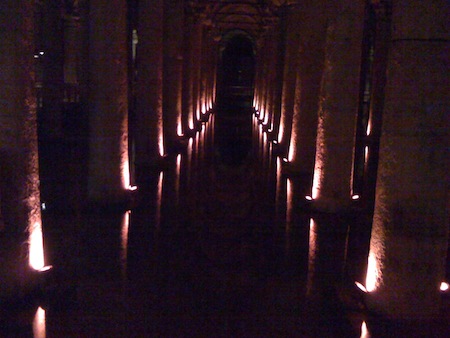
And for your vicarious tourist enjoyment, here is the emperor Justinian’s amazing cistern, which supplied water to Istanbul from 352AD onward:

cistern

Pretty cool, huh? It’s a really huge and beautiful cavern, with very little signage and tourist stuff to distract from simply hanging out there. Plus, they play awesome music. Click here to read more.

And now, readers of Leviathan, please enjoy Walker Wednesday. Today’s walker is made by paper engineering genius Theo Jansen:

Confluence Day

Just some weird confluences to report:

1) There’s a cool article about steampunk in Time magazine, which quotes me profusely.

2) The December 4 Word of the Day at Merriam-Webster is “Leviathan.” I haz proof.

3) Tomorrow morning, Children’s Literature Ambassador John Scska will be on CBS’s The Early Show to talk about good books. I hear that he’ll be mentioning Leviathan. Update: Turns out he didn’t! But he did recommend lots of other great books, including Candle Man, Book One: The Society of Unrelenting Vigilance by Glen Dakin, Going Bovine by Libba Bray, and Stitches: A Memoir by David Small.

That is all of the weirdness.

Oh, and Justine and I are in the Korean Air lounge at JFK airport, which is also the Aeroflot and Turkish Air lounge. Istanbul is a mere 11-hour fight away!

Wooosh.

The Forum

NaNoWriMo is over, so it’s time to get back to regular posting about regular stuff. Here we go.

Thing Number One:

You guys have been asking for a Forum for a while, and when I re-jiggered the site a few months ago, we planned to have one. It took a while, but it’s been active for the last few weeks.

We were working out some bugs, so I didn’t announce it here. But people randomly found it, and various interesting conversations have started. You should go check it out.

To get there, click on the Forum button on the top-right of this page (over the message lizard) or cheat and use this link.

Thing Number Two:

RH Mondadori, my publisher in Spain, had a very cool idea. After publishing Uglies and Pretties using the American covers, they decided to go in a new direction. They held a contest, the first prize of which was to be the cover model for Especiales.

The guy who won is a total fan, which is great, and he also has a definite Special look. The designer held off on the flash tattoos on the front cover, but he has one on his cheek on the back cover. (Which I don’t have a jpg of yet.)

Anyway, here he is:

ESPECIALES

I don’t actually know his name, only that he’s 22.

Thing Number Three:

Justine and I are about to head to Istanbul (aka Constantinople). If you’ve read Leviathan, you know why this is. If you haven’t, then just ignore this blog for a week or so. (Or get reading!)

Anyway, it’s going to be wicked cool. I’ll be posting photos and such here, assuming the internets are good at our hotel.

Thing Number Four:

And now it’s time for, Walker Wednesday!

walker_v2_left

Today’s walker comes from CrabFu SteamWorks, who specialize in making steam-powered robots and other toys.

Check this out:

Yes, that smoke is REAL steam that REALLY powering the walker. That’s why Keith’s Clanker walkers are always spitting out scads of smoke.

Click here for many more delicious CrabFu SteamWorks toys.

Nano Tip #29: Finish Everything

As we all approach the end of NaNoWriMo, you may be thinking, “Well, I might not ever finish this sucker, but at least I got my 50,000 words done. And that’s what I set out to do, so I’m awesome!”

Um, no.

You need to complete your NaNoWriMo novel, even if it takes you till next November. Here’s why:

Finishing is a habit, and it’s a very important ones for writers to cultivate. In fact, my very first writing advice post, back on June 26, 2005, was about finishing. So let me end my month of Nano Tips by reposting that long-ago advice, which is as true today as it was back then . . .

nanotips

Finish everything!

There will always be a part of your brain that wants to give up when characters aren’t behaving, when you don’t know where to go next, when the inspiration has faded. Don’t give the start-something-else part of your brain any extra leverage, or it will win every time. And once it starts winning . . . Well, let’s just say that the not-finishing habit is a hard one to break.

It’s easy to think up logical reasons to stop writing a story. You say to yourself: “This sucks. Why waste any more time? I’ll start something new that inspires me!”

Yeah, well, the inspiration of a new story is exciting. But if you wind up not finishing ninety percent of what you start, guess what happens. After a few years you’ll have written 100 beginnings, 40 middles, and only 10 endings. Which means you’ll be great at writing beginnings, only so-so at middles, and you’ll suck at endings. Which means you will almost certainly keep faltering between the middle and the end of every story, which means you’ll keep giving up and not finishing . . . Rinse, repeat.

And that’s a hole you don’t want to fall into. So finish, even if you know this story isn’t going to win you the Nobel Prize–it’s good practice to type THE END.


That’s it from me! Good luck with the remaining hours of NaNoWriMo. Don’t forget to check out Justine’s post yesterday, and her big finish tomorrow!

I’ll see you in December with non-writing advice posts. Phew.

Nano Tip #27: Word Clouds

We all have words we love too much.

Maybe for you it’s something fancy, like “effulgent” or “apodictic,” or something sillier, like “smellypants.” And because we love these words, we will use them too often, until our readers begin to snicker quietly at us.

But those big, obvious words are easy to spot. We’ll whack them in the second draft. And even if we fail to do so, our friends will probably slap us the fiftieth time they encounter the word “prognosticate.”

It’s the little overused words that kill us, that quietly undermine our text without us ever noticing.

My big overused word was once “just,” as an adverb. “He was just happy to see you.” “She was just standing there.” It cropped up everywhere. After this was pointed out to me by a wise editor, I went through an entire novel, deleting it everywhere it didn’t completely change the meaning of the sentence. That cured me.

But how could I be sure that there weren’t other overused words mucking up my manuscript?

Then I discovered the word cloud.
nanotips

“Word clouds” are graphic representation of the words in a text, scaled by how many times each word occurs. You’ve probably seen then in blog sidebars and Amazon listings. They’re software-generated, and therefore reveal common words that humans might overlook. (Though the software ignores super-common words like “the” and “a” automatically.) They’re also a great place to start when you begin work on your second draft.

This is what the word cloud for my latest novel, Leviathan, looked like after my first draft:

Lev wordmap
generated by the excellent Wordle.net software

As you can see, my two main character names, Alek and Deryn, are the biggest words by far.

Now, you can use word clouds to check relative importance of character names in your text, but I’m not interested in that here. (Alek is a bit bigger, but only because Deryn often goes by other names, like “Dylan” or “Mr. Sharp.” So no surprises there.) So let’s check for any overused little words.

The first thing that seems to be dominating is “eyes.” That may mean I’m relying too much on eyes for emotional cues, which could get boring. I definitely checked that as I worked on the second draft.

“Looked” is also a bit big, and got some scrutiny, I’m sure. If your characters are spending a lot of time looking at things, you probably got lazy at some point.

I also would have taken a search-pass on the word “voice,” which is often used as a shortcut to convey emotion. Too many phrases like “said Scott in a strained voice” is not a good sign.

“Feet,” “head,” and “hands,” are all big, but they’re all equal, so that doesn’t bother me as much. It’s a very physical book, after all, with lots of jumping and grabbing, and whacking of heads.

Note that I’m also ignoring interesting words, like “engines,” “walker,” and “hydrogen.” Those are just part of the world I’m writing about—airships and walking machines. I’d be worried if some cool words like that didn’t show up big.

See how it works? One glance at a word cloud can make all the difference.

To create your own word cloud, just copy and paste your entire text into this text field here at Wordle.net. Enjoy!

That’s it for today. Don’t forget to check out Justine’s Nano Tips on the last two remaining even-numbered days. See you on the 29th with my final entry!

Nano Tip #25: Read It Backwards

This is my ante-penultimate Nano Tip, so you must be nearing the end of your fantabulous NaNoWriMo novel. Soon you’ll need to read the whole thing over with an editorial eye, polishing every sentence for sparkling clarity.

But how to concentrate on mere clauses and word choice while your amazing story is sweeping you along in its wake? How can you focus on all those pesky details when your characters are bleeding heroically onto the page?

Three words: Read it backwards.

nanotips

Reading through a novel in reverse order is an old trick used by many writers. It’s like when an optometrist covers up one of your eyes to test the other. You’re covering up your “story eye” to bring grammar, spelling, and sentence structure into focus.

So what do I mean by “reading backwards”? Do you literally read the last word of your novel, then the one before that, then the one before that until you get to the beginning?

Well, that depends on what you want to concentrate on. Reading in reverse word order would bring spelling errors into sharp relief, but would probably also break your brain. No one I know does that.

A more feasible strategy is reading in reverse paragraph order. That serves to isolate sentences and word choices, without the drama of the scene pulling you past mistakes. On the other hand, if you read in reverse chapter order, you’ll be focused on the structure of individual scenes.

See how it works? The larger the unit you use for your reverse reading, the more “pulled back” you are from each level of writerly technique. But it’s up to you to discover which kinds of reverse reading are helpful for you.

Another reading-out-of-order technique I’ve used is to look at all the scenes in which a certain character appears, just to make sure they stay consistent.

Warning: if you start to get a headache, stop for a while before continuing. But don’t worry. It’s just like your first non-flipped manga; your brain will adapt eventually. That’s what it’s good at.

That’s it for today! Don’t forget to check out Justine’s Nano Tips on the even-numbered days of November. See you on the 27th.

Nano Tip #23: Change Your Brain

So . . . you’re more than two-thirds done with NaNoWriMo, and maybe you’re starting to crumple a bit. Your dialog sounds forced, your action scenes are flat, and your plot twists have all turned to spaghetti. What can you do to break out of this slump?

Here’s my tip for the day: change your brain!

“Um, what now?” you may ask. Allow me to explain . . .

nanotips

This tip was inspired by a recent article in the journal Brain and Cognition, about how traffic levels between the two hemispheres of your brain affects thinking. Researchers found that any activity that promoted neural cross-talk in test subjects also promoted creativity.

In other words, if you can get the two halves of your brain talking, you’ll be more likely to find inspiration. And it’s easier than you think.

(A quick note before I go on: most of the right-brain, left-brain stuff people repeat is total rubbish. There isn’t a “creative lobe” on one side of your head and an “analytical lobe” on the other. Both sides of your brain perform both analytic and creative tasks. The key here is to make them talk to each other.)

In this study, the subjects moved their eyes back and forth along a horizontal axis, like when you’re watching a tennis match. (Or a really boring game of Pong.) After thirty seconds of eye exercise, the subjects gained about ten minutes’ worth of improved scores on various creativity tests.

So if you need a quick hit of creativity, try looking from right to left for thirty seconds and see what happens.

Of course, you can’t move your eyes back and forth every ten minutes of your writing day. That would be dizzying and tedious. So how do you keep your creativity levels high for, say, all of November?

Luckily, there’s evidence that you can improve cross-talk levels (and thus creativity) on a permanent basis, simply by pretending that you’re left handed.

Here’s the thing: left-handed and ambidextrous subjects had no benefit from the eye movements in this study. In fact, in some studies lefties and ambies seem to get stupider after cross-talk exercises. Many scientists think that’s because lefties and ambies already operate at an optimal level of cross-talk, generated by the fact that the world is designed for right-handed people.

That’s right, all those rightie-baised scissors make lefties more creative.

Or to say it another way, being challenged by the world wires your brain for creativity!

So here’s my exercise for you today: Pretend you’re left handed. Open doors, eat, and mouse with your left hand for a day or so. You’ll be promoting cross-talk in your brain, and rewiring yourself for creativity. It may feel weird, but it should give your creative juices a boost.

And for those of you who are already left-handed or ambidextrous? Hey, you don’t need my help. You’re already creative geniuses! (Or rather, you’re already operating at optimal cross-talk levels, so you’ll have to find some other trick to make yourself smarter. Sorry!)

That’s it for today! Don’t forget to check out Justine’s posts on the even-numbered days of November. See you on the 25th.

Nano Tip #21: Writers Re-read

Being a writer should change your daily life. You should scan the newspaper for story ideas, deconstruct old fairy tales in the shower, and eavesdrop shamelessly in the name of dialog development.

And being a writer should also change the way you read.

nanotips

The next time you read a scene that makes your socks roll up, make yourself stop and learn.

Even if it interrupts your readerly pleasure, take a moment to wonder. How did the author just make you cry? Which elegant phrase or shameless trick jerked those tears from you? At what point in that action scene did your heart start pounding? What was the exact moment that you went from hating this character to liking them?

One of your jobs as a writer is to take novels apart and see how they work. Don’t go for the easy enjoyment of letting the words wash over you. Instead analyze and nitpick. Get your hands dirty.

Writers re-read.

Okay, I’m off to NCTE in Philly, so that’s it for today! Many amazing writers and I will be doing a benefit for the Philadelphia Free Library summer reading program while we’re there. Please come and support your local library!

Sunday, November 22 1:00-3:00PM
A NOVEL IDEA:
Laurie Halse Anderson, Jay Asher,
T.A. Barron, Sarah Dessen,
Steven Kluger, Justine Larbalestier,
David Levithan, Lauren Myracle,
Jacqueline Woodson and me!
Children’s Book World
17 Haverford Station Rd.
Haverford, PA

Don’t forget to check out Justine’s Nano Tips. See you in two days!

Nano Tip #19: Read Out Loud

If you ever take a linguistics class, you will hear this catechism from the first day on:

1) Speech is primary.

2) Speech is universal among human cultures, and separates us from other animals.

3) Speech is innately acquired-–-unlike writing, which is a skill that must be learned.

4) Therefore speech (not writing) is the primary material for linguistic study.

Yes, dear NaNoWriMor-ers, writing is important. But speech is the bee’s knees. So when you want to measure your burgeoning novel against a basic human yardstick, read that sucker out loud.

nanotips

Every week or so, Justine and I read aloud to each other the last few chapters of whatever books we’re writing. We like to entertain each other, but we do have one important rule: the reader is allowed to stop at any time to fix a lousy sentence, even if it leaves the listener hanging.

We’ve found this practice extremely useful for the following reasons:

1) When you read aloud, pacing issues become readily apparent.

2) It is physically impossible to read a crappy sentence without flinching.

3) Reading dialog aloud prevents unintentional hilarity.

3) Drafts are easier to share when no one can see your crappy punctuation and spelling. (In early drafts, you often don’t care about such details yet.)

5) Non-verbal responses like laughter and gasps are invaluable.

6) Novel writing is a lonely process with extremely long lag-times for feedback. Storytelling has the advantage of instantaneous feedback.

7) Loving to tell stories is why we got into this racket.

So the next time you’re stuck, consider finding a friend and reading aloud to them. Surprisingly, a stuffed animal works almost as well, because it’s not the listening that changes everything, it’s the talking.

Speech is primary.

You can still read my chat with Naomi Novik here at Suvudu.com. Don’t forget to check out Justine’s post from yesterday, about avoiding stereotypes, and her new one tomorrow. See you in two days!