New Orleans Lost; Mrs. Astor Safe

Apparently, the stories we tell ourselves never much change . . .

From The Sinking of the Titanic (1912)
by Jay Henry Mowbray

“When the first of the 56- foot lifeboats were being filled, the first stampede of panic-stricken men occurred. Within a dozen feet of where I stood I saw fully ten men throw themselves into the boats already crowded with women and children.

“About ten shots sounded in quick succession. The six cowardly men were stopped in their tracks, staggered and collapsed one after another. At least two of them vainly attempted to creep toward the boats again. The others lay quite still. This scene of bloodshed served its purpose. In that particular section of the deck there was no further attempt to violate the ‘women and children first’ rule.”

Were any of these men from the first- or second-class cabins?” Williams was asked.

“It was hard to tell. All of them were so scantily dressed. In the semi-darkness and prevailing excitement faces left no distinct impression with me. I should say that most, if not all of them, were from the steerage.

That’s right, because it’s always about the misbehavior of those louts in the cheap sections, and never about having more friggin’ lifeboats.

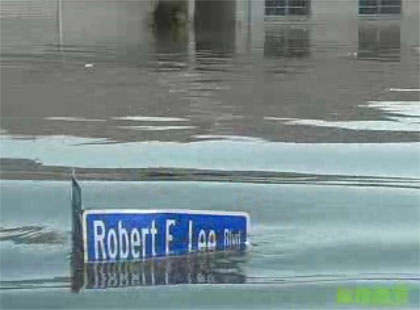
Frame capture from Jared Arsement’s home video of citizen rescue efforts. Full video available on Current TV.

Seven (or Three) Types of Time-Travel Elasticity

In a previous post, I claimed to have spent Worldcon discussing such subjects as the “seven types of elasticity in time travel” and “four types of alternate technological history.” Ted Chiang was kind enough to take time off from his furious writing schedule and inquire if I could elaborate. (Bluff-calling bastard.)

Certainly, I can elaborate. I wouldn’t just throw those numbers around like they were nothing, would I?

Tonight, I’ll start with the major forms of time-travel elasticity. Seven of them. Um, yes.

But let us start by defining our terms. For those of you who may not know, elasticity in time travel stories is a tendency for historical events to wind up the way they’re “supposed to,” a narrative device to make things palatable to those of us living in a fixed history. Elasticity is the timeline “snapping back” to its “proper” shape, more or less. Generally, TV and Hollywood time travel tales are more conservative, employing firmer elastics than literary sf, which doesn’t mind messing up the timeline a little, or destroying it altogether.

So here are the seven flavors of time travel in all their glory. Well, okay, the first three:

Type 1: The Full Elastic Jacket
Doug and Tony go back in time, and find themselves on the Titanic. So they head up to the bridge and tell the captain that the ship will soon hit an iceberg and sink. Full of Victorian hubris (okay, Edwardian hubris, and maybe some gout) the Captain proclaims, “This ship is unsinkable!”

Doug and Tony try various other avenues, but nothing they do will change history. The Titanic sinks on schedule, but not before they are whisked back into the present, having learned a valuable lesson about pride going before a sink. And that you can’t to jack with a time tunnel.

This is an actual Time Tunnel episode. It’s also the plot of a kid’s book I read once. But you know what? There are 1,005 books on Amazon with the word “Titanic” in the title, so I ain’t looking it up.


Doug and Tony weigh the ethics of saving some male Guggenheims and a few hundred lower-class types.

Type 2: Achy Breaky Time
In this schema, travelers can go back in time and change history, but they better not mess it up too much! Basically, the timeline is like your parents’ liquor cabinet. You don’t have to leave it exactly like you found it, but be careful. One drop too many and there’s going to be a freakout of major proportions.

John Varley’s Millenium is about Achy Breaky Time. Travelers from the future jump back to the present to steal people who are seconds away from dying in plane crashes. They use these lucky/unlucky souls to repopulate their own barren era.

Generally, the plane crash destroys all evidence of the travelers’ appearance in our time, preserving the timeline from paradox. But one day, a weapon from the future is accidentally left behind, survives the crash, and is discovered by a present-day crash investigator. This anachronistic artifact begins a chain of changes in the timetime, history slowly stretching out of shape. The changes build up slowly but surely, until “timequakes” start to rumble. Unless the anomaly is fixed, the timeline itself may be destroyed, which pretty much means everyone, everywhere and everywhen, is doomed. Time is elastic like a rubber band; you can change its form, but it will eventually snap.

High stakes. Except, of course, that if the heroes fail all the people they were trying to save never existed in the first place. No harm, no foul.

Also, when exactly are the timequakes happening? And when the heroes say that time is running out, which time is running out?

Type 3: Heisenberged Time
In Kage Baker’s “Company” novels, you can change history, but not recorded history. Thus the agents of the Company can go back and grab extinct species, lost artworks, and other vanished ephemera. But these agents are limited in their actions by time’s elastic, which is inscribed in the history books in their future employers’ libraries.

Exactly how this works scientifically, and what constitutes “recorded history,” is best not thought about too much. But it does eliminate paradoxes, because we all know that all the important history is written down.

Baker’s other ingenious move is to make time travel possible back to any point, as long as it’s before time travel was invented. All eras after that moment are inaccessible, which is a totally cool and Heisenburgian idea: The invention of time travel has changed the nature of time itself, changing it from elastic to totally locked up and inaccessible.

Okay, that’s three. I’m going to sleep now, and I’ll do the other four . . . soon. (Help me out here, guys.)

And then the four types of alternate technology. Oh, yeah, looking forward to those.

Still Floggin’

Okay, okay! Peeps Week is over! But this time, I’m selling someone else’s book.

We’re in New York right now, but at this moment in Australia, copies of Justine’s first novel are hitting the shelves. It’s 10,000 miles away, Monday morning rather than Sunday night, and at the end of winter instead of summer, but we can still feel it happening . . .

.

Magic or Madness is the story of a girl negotiating the same two worlds that Justine and I find ourselves torn between: Sydney and New York, winter and summer, magic or madness. (Though the latter, in our case, is only occasional.)

Here Justine explains how the book came to be, and here are some of her excellent reviews. Read them, and I think you’ll be intrigued. Read the book, and you’ll be blown away.

Magic or Madness came out in the US way back in March, but Americans can still find it on shelves, or Amazon.

But if you’re in Australia, take a look for it in bookstores everywhere. We wish we were there to see it ourselves.

Buy or Die

Okay, the flogging is almost over. Peeps comes out today.

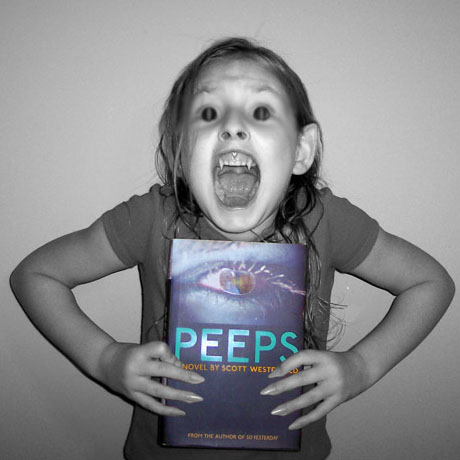
Go buy it, or the small child visits you!


Photo: John Scalzi. Model: Athena, of the Scalzi Agency.

And thanks to everyone working to make Peeps Week a success:
Gwenda
Cory
Jonathan
Margo
Barry
Scalzi
Shane
Lauren M.
Diana (whom I don’t even know)
Lauren C.
James

And of course extra thanks to my one, my only, my always . . . Justine.

Read the reviews.

Buy it here.

Single White Parasite . . .

Somewhere in an alternate universe this Thursday, this book is coming out:

Here’s how it all began . . . The first title for Peeps was Carrier. This fit better with the original concept for the book, which focused on a character who, like Typhoid Mary, carried the disease of vampirism without actually having the “symptoms.” As that concept morphed into something else, I realized that “Carrier” wasn’t such a great title after all.

The second title was The V-Word, which had a vaguely chick-lit feel to it. Then the title above, Single White Parasite. My editor took me quietly aside to suggest a re-think.

In my last post, I mentioned how cover limbo is like band-name limbo. If you’ve ever been in a band, you’ll remember that moment when you’ve been trying to pick a name forever, so everyone sits around saying stuff like, “Why don’t we call ourselves The Chairs. Wouldn’t it be cool? ‘Cause we’re all sitting on chairs right now!”

Well, novel-title limbo is even worse. Writers must realize that if those few words in their title suck, there’s some sizeable number of people who won’t bother to read the other 70,000. And that means you starve and die.

Here are a few examples of my other books that went into title limbo:

Evolution’s Darling was called Economies of Measure forever. Although I still think that’s a classy title, my publisher took me aside and said, “Sounds like a textbook.” There were hundreds of intermediate stops before I came up with “Evolution’s Darling.” In the end, I actually added a paragraph in which the term “Evolution’s Darling” came up, just so I could use it as the title.

Risen Empire was originally called Succession, but Tor didn’t like that because they’d just had another book with a similiar title. But I got to keep “Succession” as the series title.

But back to the book that comes out this Thursday. Finally I realized that my word for vampires, “parasite positives,” was a perfect title. And Peeps was born. And I’m very happy with it.

Of course, in the alternate-alternate universe, I wound up with this title and cover combination:

Ewww.

Peeps Week!

As you all no doubt remember, Peeps comes out this Thursday, August 25. This is my first novel to be released during the lifetime of this blog, so let the flogging begin!

This is officially Peeps week. And that means all Peeps, all the time. Peeps. Peeps. Peeps.

“But, Scott,” you say. “I already plan to buy several copies of Peeps. What more can I do?”

Excellent question. First, try to work the word “Peeps” into conversations. As in, “I could really go for a mouthful of chewy marshmallow Peeps at this time.” For this week only, each time you use the word “peeps,” you’ll be credited with one dollar (in nonredeemable peeps money, of course).

When that gets boring (as if) feel free to discuss these alternate Peeps covers with your friends . . .

Obviously, the two on the right were rough drafts only. They may look crappy at this stage, but I’m sure Razorbill’s excellent designer would have whipped them into much better shape. Still, I must say I’m glad that the mighty embossed cat eyeball won out.

Here’s what happened: Between those first two covers and the final at right, several agonizing weeks passed in cover limbo. Razorbill always gives Justine and me a fair amount of input, and I didn’t much like the psycho twelve-year-old of the middle cover, prefering the older look of the leftmost image. My publisher disagreed, though, as she was already worried about the book being “too old.”

Frankly, I wasn’t thrilled by the first two cover concepts at all. Somehow, spaced-out monochrome girls give me a weird junkie vibe. I’m not a huge fan of baby-poo yellow on title treatments, either. The only thing that we all agreed on was that the glowing eyes were cool. If only we had focused on that concept earlier, many lives might have been saved.

Cover limbo is like band-name limbo. It’s easy if you start out with something that everyone loves. But once the first few attempts fail, everybody involved–author, editors, designers–goes off in their own direction, until the whole process becomes an endless journey of random images.

During the limbo period, I was all about teeth. “Give me a real x-ray of a jawbone,” I proclaimed. “But with fangs!”

Strangely, no one could find any actual x-rays of vampires. Apparently, it’s like mirrors. They just don’t show up.

But fortunately someone (not me) realized that cats play a key role in Peeps, and came up with the final concept. When I saw the first rough I breathed a sigh of relief. Then when the final bound book appeared at BEA, the mighty eyeball embossing won me over completely.

What’s that? You can’t see the embossing online? Well, there’s only one cure for that.

Come this Thursday, go buy that, uh, book. You know, the one with that title . . .

Regular Blog Day!

Okay, I really don’t have very much to write about today.

After getting Boingled, though, my hit rate was sky high, and it’s drying up faster than a dead dog on a Texas highway. I just can’t stand to see all those readers slip away. So I’ll use the time-tested strategy of so many regular blogs, and tell you random crap about my week:

Random Thing 1: Today I wrote almost 2,000 words of Specials (Book 3 of Uglies). That’s an excellent day’s work, which is what I’ll have to manage from now until September 12, when it’s due. I think they were good words, but I never know until the next day. Plus, there will need to be an action scene soon. Or perhaps a hoverboard chase.

Random Thing 2: On September 13, Justine and I are headed to Mexico for a month. It’s a writing holiday for her to start on the third Magic or Madness book and me on a possible sequel to Peeps. I can’t wait to show you pictures of San Miguel.

Random Thing 3: The night before last we went to a party hosted by our friend Lauren Cerand, and the blogtastic Maud Newton was in attandence. It was tons of fun, although yesterday was spent with bodacious hangover.

Okay, that’s enough of this. Next time, a real post. But first, since we’re being a regular blog today, a cat picture:


This is Millhouse, who came with an apartment we borrowed in Buenos Aires. He is named after the Simpsons character, and made us love him with his quiet wisdom and impeccable comic timing.

Peeps is Boingled

Last night, Cory Doctorow posted a nice review of Peeps on ur-techogeek blog Boingboing. A short excerpt:

Scott’s managed to write a vampire novel without ever once visiting the tired old tropes of horror fiction. Instead, he invents marvelous, scientific explanations for the characteristics of vampirism . . . This is some seriously inventive science fiction, written in an engaging style that’s bound to spark young readers’ interest in biology and parasitology (there’s a short bibliography on parasites at the end of the novel). For adults, this scientific take on a hoary old subject will inspire admiration in the ability of an original talent to mine fresh ore from even the oldest veins.

But you really must read the whole review.

Boingboing is the first stop on my blogroll pretty much every morning, and yet my savvy publicist at Razorbill managed to spot it before I did. Thus, the news had already spread around the Penguin office, where it was pronounced an excellent way to start the week.

And in keeping with the theme of my last post, all of this happened because I pressed Peeps into his hot little hands at Worldcon. So thanks again to Glasgow, and to Cory, both for this review and for being a force behind one of my favorite media spaces.

Loving the tribe even more now.


Peeps comes out August 25,
but feel free to buy it now.

I Love the Tribe

We just got back from Worldcon 2005 at Glasgow, and I’ve been reading through the blogs of various friends checking for mentions of me, like a senior counting pictures in a school yearbook. Having come home to three lovely houseguests, I don’t have time for my own detailed con report, so sorry if you’re combing this blog for a mention of yourself. But I will proclaim these words:

I love the tribe. I went to parties where almost every conversation was fascinating. I can meet at least ten cool new people in a matter of four days. The future is in good hands.


The Hugo Awards happened here, yo.

What I’ve realized is that a science fiction convention has the same emotional arc as a really excellent five-day wedding. The pre-travel wondering if you can get out of it. The reunions with con-friends, whom you see as infrequently and love as much (and can tease as hard) as family. The cool new people you bond with over the parties, ritual gatherings, not enough sleep and too much drinking. The central event you get dressed up for—Hugo Awards Ceremony, World Fantasy or Nebula Awards Banquet, the Tiptree Auction—that you’ve all supposedly come long distances for. And those parties after the Big Event, your last chance to drink a lot and proclaim that the marriage is doomed, or that the Hugo went to the wrong short dramatic presentation.

And like a really fabulous extended wedding, I am always a bit mushy at the end. Leaving all those new and old friends is painful, and coming back into the real world can be a bit harsh. Especially dealing with all those outsiders who are so indifferent to the special rules of the place where you’ve just been.

Take, for example, coming home to the New York Times’ review of Kelly Link’s new book, which was generally positive but contains this astonishingly mundane line about her story “Zombie Contingency Plans”: “The premise is fresh and the characters are likable . . . but . . . those zombies–are they supposed to be a metaphor?”

Argh. Are those not of the Tribe really so dim-witted? Are our skiffy reading protocols really so hard to understand?

Allow me too explain, Mr. Non-sf-Reading Reviewer Man. Sure, zombies can “be a metaphor.” They can represent the oppressed, as in Land of the Dead, or humanity’s feral nature, as in 28 Days Later. Or racial politics or fear of contagion or even the consumer unconscious (Night of the Living Dead, Resident Evil, Dawn of the Dead). We could play this game all night.

But really, zombies are not “supposed to be metaphors.” They’re supposed to be friggin’ zombies. They follow the Zombie Rules: they rise from death to eat the flesh of the living, they shuffle in slow pursuit (or should, anyway), and most important, they multiply exponentially. They bring civilization down, taking all but the most resourceful, lucky and well-armed among us, whom they save for last. They make us the hunted; all of us.

That’s the stuff zombies are supposed to do. Yes, they make excellent symbols, and metaphors, and have kick-ass mythopoeic resonance to boot. But their main job is to follow genre conventions, to play with and expand the Zombie Rules, to make us begin to see the world as a place colored by our own zombie contingency plans.

That’s why I spent last weekend drinking Scottish ale and discussing in great detail the seven different kinds of elasticity in time travel, the four major flavors of alternate technological history, the author’s duty of care in making military far-future hierarchies believable, and which nationalities of vampires can go out in the sun (Japanese, Swedish, discuss). And yes, I did spend some time talking about how I’d get out of the Glasgow Hilton hotel bar in case of zombie attack.

Don’t you see why this is more vitally important than your poxy metaphors, Mr. Times-Reviewer-Man?

Stories are the original virtual reality device; their internal rules spread out into reality around us like a bite-transmitted virus, slowly but inexorably consuming its flesh. They don’t just stand around “being metaphors” whose sole purpose is to represent things in the real world; they eat the real world.

Which made it rather painful to finally lift up our heavy luggage and come home, to live again among all these people who see the operations of language and storytelling in, quite frankly, a sophomoric English-class sort of way. All these people with their appalling lack of zombie contigencies. (Or maybe their dim-wittedness is, like, supposed to be a metaphor. What the hell do I know? I’m just a science fiction writer.)

Anyway, I really had a good time. Thanks to Glasgow, and all the organizers and volunteers, for lifting me out of the real world for a while. You rule.

Plus . . . Orbit, the UK publisher of Risen Empire, bought Midnighters for their young adult line.

W00t! Midnighters with slightly different spelling and punctuation! And with many more readers!

Glasgow was my first time meeting the Orbit crew, and they were all extremely cool. I look forward to publishing many more books with them in the future. (And the sale makes that whole pound-sterling-eating mother of a trip totally tax-deductible. Righteous!)

Gone to Scotland

Like the rest of the Tribe, I’m headed off to Scotland for the World Science Fiction Convention. Worldcon will consist of about 6,000 of us skiffy-heads talking about the death of publishing, the probable shape of the future, and the state of Scottish cuisine. And possibly we’ll also be drinking beer.

I may or may not be posting much, but like all such affairs, Worldcon will be extensively photoblogged, warblogged, and real-time transcribed. Five minute’s research will no doubt turn up embarrassing photos of me or any other sf writer you’d care to google.

Actually, it doesn’t start until next Thursday, but in the meantime we’ll be staying in London with Justine’s sister Niki and our pals Lauren and Andrew. Have to make up for all those lost tourism dollars, bravely ride the underground, stiff upper lip and all that.

Here’s my Worldcon schedule:

Thursday 8:00pm The Military – Getting It Right
Does it matter if we don’t get the equipment right? Is it ok for fictional military characters to sound like boy scouts? Is there a military ethic that we have a duty to get right? What matters to readers in uniform? With Simon Bradshaw (M), Paul Chafe, Richard Morgan, Scott Westerfeld, and Karen Traviss.

Ever since I wrote the space operatic Risen Empire, I’ve been put on military panels. This topic is a bit more focused than most, however, and look interesting. Of course, the answer to all the question depends on what you mean by the military: Imperial storm troopers grown in a vat? Or 19-year-old reservists with Arab phrase books trying to quell 4,000 years of Babylonian bloodshed?

Friday 11:00am Why Write for Children/YA?
A recent advertisement for a Canadian first novel award included the line “if you have previously written children’s books, you are still eligible.” With that kind of attitude, why do we bother? With Julie Bertagna, Oisin McGann, Janet McNaughton, Sharyn November (M), Scott Westerfeld, Jane Yolen.

Dude, I’m on a panel with Jane Yolen! This should be fun, although the petulant tone of the description strikes me as odd. Didn’t they get the memo about how YA rules the world? And how everyone and their dog is switching over? (Except Walter Mosely’s dog, who’s writing a science fiction novel. Sucker.)

Saturday 1:00pm Autographing
Me and James P. Hogan, Justina Robson, Liz Williams, and Charles Stross.

Monday 11:30am-12:00pm. Reading
I’ll probably read from Risen Empire, seeing as that’s my only book out in the UK this year. Uglies doesn’t reach those shores until spring 2006.

That’s it. The rest of the time I can be found in the bar. You know, that bar in Scotland.

Church sign courtesy of the Church Sign Generator.