Last Days News

First thing: According to G. Jules, The Last Days (sequel to Peeps) has appeared in the wild (Indiana, specifically)! So presumably it’s leaking onto bookstore shelves everywhere. Go and buy it!

Has anyone spotted the paperback new version of Peeps?

For those of you who haven’t been following my appearances page, I have a couple of gigs coming up in NYC.

NYRSF Reading Series
Tuesday, September 5, 2006
7PM (doors open at 6:30PM)
Justine and me
Melville Gallery
213 Water Street
New York, NY

This will be a full-on reading, like 20 minutes each. So come along if you want to hear our dulcet tones.

Books of Wonder
Thursday, October 5, 2006, 5PM-7PM
Susan Cooper, Ellen Kushner, Gail Carson Levine,
Celia Rees, Delia Sherman and me
18 W. 18th St
New York, NY

This will be more of a signing, with only some hellos and a Q&A session, as there are so many of us.

Next month Justine, Maureen Johnson and I will be doing a panel for the Brooklyn Writers’ Festival. Watch this space for details.

Please send in any more sightings of The Last Days!

And finally for your viewing pleasure: Six Horrifying Parasites.

Goodbye, and Thanks for All the Ice

Before I head off to Worldcon 2006, three bits of news:

1. There’s a profile/interview with me in Publisher’s Weely about The Last Days. The interesting thing is, it ran in the Religion Bookline section.

Basically, reporter (and religious scholar) Donna Freitas and I sat down for lunch the other day, and talked about apocalypses. See what you think.

2. Peeps has been short-listed for the Queensland Premier’s Award for best YA novel of 2005. Yay, me, and ongoing yays to Penguin Australia for giving my books a home in my adopted country.

Yay also to my fellow shortlistees! (Having trouble with the Queensland site right now. Will have to explore this when I get back from CA.)

3. Pluto = toast.

Yeah, that’s right. I knew that 12-planet thang was gonna fall apart. (In fact, I had dinner with reknowned sf writer Samuel R. Delany the other night, and was glad to hear that he was anti-Pluto as well.)

So goodbye Pluto, and thanks for all the ice.

I’m out the door to California to conventionize and talk to the screenwriter who’s working on Peeps and The Last Days movie(s). More on that later.

Ciao for now.

O, Mighty Dump Bin

News from the wild: Uglies has its own dump bin!

For all you non-publishing industry types, a “dump bin” is one of those cardboard palaces that gives your novels their own little theme-home. Like Barbie’s beach house for books, sort of:

Dump bins are paid for by the publishing company, which humbly begs the bookstore (B&N, in this case) for the right to install them. They cost a lot, but they also attract a lot of eyeballs. Yay for S&S!

This bin was photographed in the wild by Diana Peterfreund, whose debut novel Secret Society Girl just came out last month. It’s a total page-turner about conspiratorial college hi-jinks. (Justine gives it a mini-review here.)

Special props to Diana for breaking the rules. For you see, you’re not allowed to take photos in B&Ns! They think we’re stealing their shelf arrangements, or something. (Stay as bad as you are, baby.) She’s also recently converted from Plutophancy, which is always good to see.

And also check out her hilarious account of having to outline a book for her editor, and her lovely review of the Midnighters series.

Now go buy things of hers and mine.

Pluto Update
The iceball is probably toast:

The bottom line, said the Harvard astronomer Owen Gingerich, chairman of the Planet Definition Committee of the union, is that in the new definition, “Pluto is not a planet.” —NY Times, Aug 23, 2006

Silliness

Maureen Johnson, author of Little Blue Envelopes and the very funny The Bermudez Triangle, hung out with Justine and me last Friday, and describes our day in this VERY SILLY POST.

We had a blast, but I don’t think Maureen got all her facts straight. For one thing, I don’t remember ever calling anyone “kiddo.” And I can fly a helicopter, and read lips, or at least I assume I can.

For more of Maureen’s extreme silliness, check out here next book, Devilish, which comes out September 7. It’s about a demon who shows up in 16-year-old girl form at a Catholic high school, ready to buy some souls.

September 7 . . . That’s right! The same day as The Last Days!

So many books, so little time.

Galapagos Reading

In all my perterbations about Pluto, I almost forgot about an appearance I’m doing tomorrow night as part of The Last Days month!

Here’s the scoop about the event, a night of strange and varied entertainments celebrating the release of Jeff VanderMeer’s new novel Shriek: An Afterword.

It’s a big multimedia extravaganza that includes my pals Ellen Kusher and Delia Sherman. But the big event is a screening of “Shriek: The Movie,” a short film based on the novel, directed by Juha Lindroos and with an original soundtrack by legendary art-rock band The Church.

I’ll be reading from The Last Days for the first time ever.

Here’s an important note for young fans: Galapagos is a bar, and you have to be 21 to get in. (Sorry.)

It’s $7, and here’s where it is.

The Last Days is a sequel to Peeps, comes out September 7, and can be pre-ordered now.

Plutophants in Disarray

I’ll say one thing: Not having a coherent scientific theory can lead to factionalization.

Strains appeared today among the Plutophants, as many among their number were dismayed by the latest IAU attempt to keep Pluto a planet. The new transparently plutophantic scheme involved no less than four categories of planets:

1. Terrestrial
2. Gas Giant
3. Dwarf Non-Pluton (a special class for Ceres, formerly an asteroid)
4. Dwarf Pluton (for literally dozens of ice dwarfs)

Or something like that. No one’s really sure if you have to say “dwarf pluton,” or whether all plutons are automatically dwarfs, or whatever.

Appropriately, those of us following the Pluto issue have also spilt into four categories, the Pluto-haytas (who will win) and three groups of fractured plutophants.

For those of you following at home, here’s a quick rundown:

1. The No Iceball Left Behind Group

The NILBies are the bunch who officially won today. They produced the bizarre scheme above, following the philosophy that planet-ness is primarily all about roundness. Asteroids, ice balls, whatever—if it’s big enough for its own gravity to squish it into a sphere, but not so big it undergoes fusion (becoming a sun), and it’s not a moon, it’s a planet.

Many Plutophants were happy at first, because this means that Pluto and UB313 are definitely planets. But soon the scales fell from their eyes, and they realized that the NILBie victory spells doom to Pluto in the long run.

Why? Because it means scores of trans-Neptunian planets will appear almost instantly. Like a sweaty Joe McCarthy, the IAU brandished a lit of 43 known plutons, and admitted they have a secret list of dozens more.

This is your solar system:

This is your solar system on NILBie:

Hmm.

Of course, not all Plutophants want the nonsensical scribbles above, which brings me to:

2. The Culture Vultures

The Vultures are a hardy band of simple folk who believe that the mnemonics of their childhood are in fact the laws of the universe. Oh, sure, they make claims about “planets” being a “cultural” term, because, you know, science changes, but culture has always been the same.

The Vultures are sort of like those people who think that popular music was perfected while they were in high school, and wonder why all these new bands even exist.

So Pluto will never change in their lifetime, anymore than Supertramp can ever be replaced.

They’re happy with the current mess, thinking that as the clearly insane NILBies inflate the term “planet” to meaninglessness, the rest of culture will fearfully retreat to the warm glowing warmth of the “nine historical planets.”

That’s their new buzzword, “Nine historical planets.”

Because, like, history stops in 2006?

The Vultures seem to forget that our culture:
Once called the sun and moon “planets”;
Once called whales “fish” (see the King James and Moby Dick);
Once used the word “animal” to refer solely to non-human animals.

In all of these cases, the scientific usage ultimately won. Maybe people sometimes say, “Delta doesn’t allow animals onboard.” But asked to define animal, they’ll admit to the scientific definition after a moment’s thought. And anyone who says that whales are fish, or the sun a planet, is pretty quickly shouted down.

If scientists start saying “eight planets” a lot, so will the rest of us. We listen to scientists, at least when it comes to stuff like planets. That’s part of our, you know, culture.

More on that later. Because here’s our final Plutophantic faction:

3. The UB313 Guy

This is a faction of one: Mike Brown.

He’s one of the guys who discovered UB313, which will be made a planet under the new NILBie scheme. But he realizes all too well that his discovery will be made much less interesting, given that 50-something other planets will appear with the same stroke of the pen. (He coined the “No Iceball Left Behind” slur.)

In the NY Times today, he freely admits that eight planets is the logical scientific number. But then he rhapsodizes a bit about the Culture Vulture argument, with one slight change . . .

He thinks UB313 should be a planet, too.

I’m biased, but I like to imagine this question through the eyes of the child I was in the 1970’s . . . If I had heard back then about the discovery of something at the edge of the solar system, I wouldn’t have waited for a body of astronomers to tell me what it was. I would have immediately cut out a little disk of white paper and taped it to the poster of planets on my bedroom wall. That night, I would have looked up, straining to see the latest addition to our solar system, hoping that I, too, might someday find a new planet.

I hope the union . . . simply declares 2003 UB313 our 10th, full-fledged planet. Doing so might convince schoolchildren to put new paper disks on their walls, to look up to the sky and realize that exploration does continue, and that they can be part of it, too.

Well, except they can’t, Mike, because it’s pretty much all iceballs from here on out.*

But at least your iceball wouldn’t be left behind.

Which brings us to . . .

4. The Pluto-Haytas

So while the Plutophants are crumbling into disarray, what does head Pluto-hayta Neil deGrasse Tyson have to say?

“A Plutophile is well served by this definition,” he said. “It is one of the few that allow you to utter Pluto and Jupiter in the same breath.”

Diss!

Dissing aside, though, here’s my new plan: Let’s get rid of Pluto by whatever means necessary. It’s a friggin’ iceball, okay? Let’s keep saying “eight classic planets” until everyone drops the “classic.”

But before we define the word “planet” for all times and all places, why not wait until we have observed ten or so other solar systems in their entirety? Out there in the rest of the galaxy, there may be all kinds of crazy stuff:

Multiple accretion disks!
Ice-worlds big enough to impress even me!
Objects that aren’t round, but are still totally planets!
Captured rogue gas giants with wacky orbits!

We just don’t know yet. And we don’t want to wind up like the ancients who thought the sun was a planet, until they figured out that we went around it. And we don’t want to wind up with a bunch of lame iceballs lumped in with the cool stuff, just because of the pathetic Plutophants.

This ain’t about your bedroom walls, kiddies, it’s about the universe. So let’s get some more of the universe under our belts before making final judgements.

So Pluto’s not a planet. It’s an iceball. Deal.

Cthulhu Can Eat Me

John Scalzi and I have been warring for the last few months (seems like years) over the subject of whether Pluto is a planet or not.

Of course, it is not. Even the Pluto-sympathetic IAU, which is meeting this month to discuss such matters, will probably politely demote it to “dwarf planet,” “ice dwarf,” or some other humiliating category.

But in his slavish devotion to schoolchild memorization exercises, Scalzi will not give up the fight. Now he’s even impressed his charming daughter into the doomed struggle.

Watch in awe as Cthulhu eats me, Scott Westerfeld, in effigy.

Okay, I’ve avoided the subject on this blog, because it’s Last Days Month, after all. But enough is enough! Because when in the course of human events it becomes necessary for one heavenly body to dissolve the astronomical bands which have connected it with another and to assume among the powers of the solar system the separate and superior station of “planet” to which the Laws of Nature entitle them, and to demote the other to the station of “ice dwarf,” a decent respect to the opinions of humankind requires that the inhabitants should declare the causes which impel them to the separation. So . . .

WHY PLUTO IS NOT A PLANET

Position


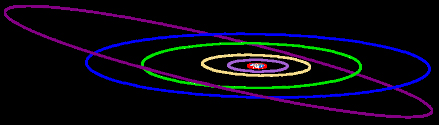
Hey, look! One of these things is not like the others. That’s right, the purple one. It’s all over the place: inside Neptune’s orbit one decade and then outside the next; topsy-turvy and crooked. Or as an astronomer might say, “Several orders of magnitude more elliptic and eccentric than the eight real planets.”

By the way, that red splodge in the middle is the four terrestrial planets: Mercury, Venus, Earth, and Mars.

And see how neat the eight real planets are? Why are they all in a plane like that? Because they all formed from the same disk of material (known as “the accretion disk”) and are therefore all cousins. They are related.

Pluto is just a crappy piece of leftover, non-accretion-disk ice. Which brings us to . . .

Composition

Pluto’s exact composition is not known, but a third to a half of the dwarf is almost certainly composed of ice. That’s right, it’s almost equal parts rocks and water, and we have a name for rock + water objects in space: comets.

Pluto is compositionally a comet. And that’s why its orbit is incredibly eccentric. A little more eccentric, and it would be lighting up our skies as it melted away, and would be called “Tombaugh’s Comet” or something like that.

History

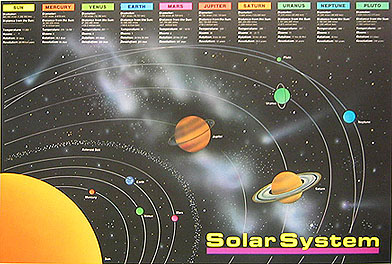
Now here’s where the Plutophants always get nostalgic. They think that the millions of plastic Denny’s placemats printed over the last 70 years that call Pluto a planet somehow legitimate the term. Pluto should be “grandfathered” in, or maybe we should make a special name like “minor planets” for Pluto and its numerous Kuiper Belt pals.


Image courtesy of Northwest Nature Shop. Get them while they still make ’em.

But here’s the problem with that, Plutophants: we’ve been down this road before. And your side LOST!

In 1801, Guiseppe Piazzi discovered a new “planet” called Ceres Ferdinandea. The lame last name was soon dropped, but otherwise everyone was thrilled and excited. Then a second “planet” was spotted in Ceres’ orbit, called Pallas. Then two more: Juno and Vesta.

Now, some folks immediately suggested downgrading Ceres and its buddies to non-planets, and suggested the term “asteroids.” But the Ceres-lovers refused, because planets are wonderful and pretty and Denny’s had already printed up some lovely placemats!

In 1828, a book called First Steps to Astronomy and Geography listed the planets as, “Eleven: Mercury, Venus, the Earth, Mars, Vesta, Juno, Ceres, Pallas, Jupiter, Saturn, and Herschel.” (Herschel is the old name for Uranus, changed to facilitate the snickering of generations of schoolkids.)

That’s right, we had eleven planets, and that was before Neptune or Pluto hit the scene.

From 1845 to 1851, 11 more “planets” were discovered in Ceres’ orbit. It was pretty clear to everyone that things had gotten out of hand. But the always optimistic planet-o-philes didn’t want to outright demote anyone, because that would be mean.

So they came up with the lame idea of “minor planets.”

In 1866, the Paris Observatory first used the description “petites planets” to describe the ever-more-numerous asteroids. Tellingly, Ceres, Pallas, Juno, and Vesta were “grandfathered” into the ranks of full planets at first. (I didn’t know they had Denny’s in Paris back then.)

The U.S. Naval Observatory went psycho for a few decades, using the word “asteroids” until 1868, then switching to “small planets,” then back to “asteroid” in 1892, then to “minor planets” in 1900, and at long last to “asteroids” in 1929, only a year before Pluto was discovered.

Phew. Close call there.

Other organizations used various wordings, but by the beginning of the twentieth century, the Denny’s-eating, planet-loving lobby had been largely defeated.

This, my friends, is exactly what will happen to Pluto. Yes, the IAU may come up with “minor planet” or “dwarf planet” or some such drivel, but as new discoveries mount, and the list of “planets” get longer and longer and more and more embarrassing, we’ll slowly stop using that word. And by the way, we’re not talking about mere dozens of planets here; some estimates put the number of significant Kuiper Belt objects in the tens of thousands. But long before we find that many, we’ll be calling Pluto what it is:

The King of the Kuiper Belt!

Which brings me to my final point . . .

Common Decency

Why would Pluto want to be a planet?

As a planet, it’s a tiny little, out-of-whack runt! As a Kuiper Belt Object, it’s a rocking big heavyweight bruiser. Okay, not quite as big as UB313, but it’s got more moons!

So as a matter of common decency, we should realize that Pluto would rather rule in the icy reaches of the Kuiper Belt than be subject to mockery in the warm glowing warmth of the inner solar system. It’s named after the god of the underworld, after all.

But the Cthulhu doll was cute.

For even more detail on the “minor planets” of the nineteenth century, written by people who (unlike Scalzi and me) actually know things, check here.

Zombie Cockroach!

In the spirit of Last Days Month, I’ve decided to dust off a few old parasite posts I’ve been meaning to do. So . . .

Meet the exoparasitoids!

Um, what? Well, do you remember toxoplasma, the beastie that lives in peoples’ brains and makes them act like cats? (See chapter 5 of Peeps for details.) Toxoplasma lives its entire life inside other animals; it’s a pure parasite, in other words.

But exoparasitoids spend most of their lives as free-living animals, flying or walking or swimming around like the rest of us. But at certain stages of life, they transform into parasites, sort of like werewolves turning from human into beast. An example of this in Peeps is the screwflies of chapter 10. They are normal flies as adults, but they grow up as parasites.

A few days ago, I was checking out Carl Zimmer’s blog and came across a post about a wasp called Ampulex compressa. Ampulex lives its life like a normal wasp, until it gets ready to lay eggs, at which point it becomes a full-fledged, zombie-cockroach-driving parasite!

Warning to the squeamish: Stop reading! Flee to Kitten War right now!

So what happens is this: when Ampulex is ready to lay an egg, it stings a cockroach on its belly, temporarily paralyzing it. Then it sticks its stinger into the roach’s brain, performing a little bit of neurosurgery. When Ampulex is done, the cockroach’s willpower has been destroyed!

It’s a zombie cockroach, a slave.

Ampulex takes it by the antenna and leads it home. The roach meekly follows, allowing itself to be sealed up inside the wasp-lair.

Do you think what happens next is pleasant? Then you would be wrong. (But Kittenwar is still available.)

Ampulex lays its egg, and when the larva hatches it eats its way into the enslaved roach, feasting on its organs. After growing into a fully formed wasp, it pops out in Alien fashion, as shown in the photo above.

Was that fun? Then tune in next week for parasitic cancer!

Plus, go buy The Last Days. Or the new paperback of Peeps!

Don’t they look pretty together?

And if you want to check out where all my parasitology is stolen from, go buy Zimmer’s book, Parasite Rex.

Last Days/First Lines

The Last Days, sequel to Peeps, comes out in exactly thirty-one days. So I hereby proclaim this Last Days Month!

We’re kicking off the festivities with a strange literary experiment. Below is a “poem” made from the first lines of every chapter of TLD, in order.

Some chapters have been censored by the Spoiler Control Board, but you still may get flickers of plot, character, and theme. Those with weak spoilage tolerances should look away now!

One explanatory note: The book has five points of view, both male and female, so it’s sort of like Midnighters. Except it’s in first person, like Peeps.

So here we go, and see if you can spot Westerfeldian first-line-of-chapter technique in action!

1. I think New York was leaking.
2. “You know what the weird thing was?”
3. The next day, Zahler and I saw our first black water.
4. The new girl was intense. And kind of hot.
5. “One of those boys was rather fetching.”
6. Pearl was glowing.
7. My dogs were acting paranormal that day, all edgy and anxious.
8. Times Square was buzzing.
9. I took the subway to Brooklyn, so Mom wouldn’t find out from Elvis.
10. Pearl was shiny, glistening, smelling of fear.
11. I got there early, just to watch.
12. Her uncovered face was radiant, shining with a brilliance that liquified me.
13. The halls of Julliard seemed wrong on that first day back to school.
14. CENSORED FOR SPOILAGE!
15. It felt weird, waiting for 1AM exactly.
16. Mozzy was taking forever.
17. I’d bought a new dress for this, and nine kinds of makeup.
18. CENSORED FOR SPOILAGE!
19. When the doorman heard our names, he didn’t bother to check the list or use his headset.
20. The noise in my body never stopped.
21-29. ALL CENSORED FOR SPOILAGE!

Hmm. That was . . . weird.

One thing is obvious: I like my first lines short and declarative. No complicated sentences, except maybe chapter 19. Of course, that’s not really a Scott thing. It’s pretty classic grab-the-reader technique, though it can look weird when all the first lines in a row like this.

Something more particular to me (and that I didn’t realize until now) is how groups of similar concepts tend to repeat close together:

1-3. “leaking” and “water”
4-5. “hot” and “fetching”
6-12. “glowing,” “shiny,” “radiant.”
7-10. “buzzing,” “edgy,” “intense”
10-13. “smelling of fear,” liquified me,” “seemed wrong”
15-16. “waiting for 1AM,” “taking forever”

That’s kind of cool. And you can sort of see the book progress in those groups, from anticipation (water dripping), to attraction (fetching and shiny), to growing intensity (buzzing), to fear (and wrongness), and then a pause before the storm (waiting, taking forever).

But thanks to the Spoiler Control Board, you didn’t get any lines from the climax of the book, so it’s hard to show what happens next. (Heh, heh.)

Anyway, I hope that makes you salivate at least a little.

“Last Days Month!” I say again.

UDPATE:
I started a mini-meme!

E. Lockhart, author of The Boyfriend List and Fly on the Wall, has posted her own first-line poem, using the first lines from her upcoming novel The Boy Book.

I haven’t read it yet (though I loved Fly on the Wall), but the first lines give you an excellent sense of the novel’s voice. Very salivating-making.

Code Cool

Over a year ago, I blogged about So Yesterday being translated into French. I also had a contest to see who could guess what the French title would be. And now I’m here to announce the winner . . .

No one!

That’s right, no one. You have just won a signed copy of So Yesterday, to be shipped to your home in Nowheresville. Because no one guessed the title of So Yesterday in French, which turned out to be in English: Code Cool.

I like the title, actually, and the cover too. It’s kind of . . . French. (They love the comics, I hear.)

And because no foreign rights news is complete without it, here’s a Google translation of a review:

That starts with a chapter 0 which sounds like a warning: “you are encircled (…) we are invisible”, where an not-identified narrator warns to us counters mysterious Saboteurs ready to destroy the order of the things. Then it is thought that a Master of the malefic forces perhaps – still – will try to destroy humanity, or that a vast governmental plot will reduce to us in a future immediate to the state to robots. That nenni. The history of the Hunter young person and his friend Jen, seventeen years both, speaks primarily about look, of mode, of cequi is “cool” and of how one decides that that becomes it.

Code Cool depicts a world pitilessly arranged hierarchically, Petri of codes, rules, studies marketing in which Hunter evolves/moves like a fish in water. But here is that the daily newspaper of the young man is pertubé by the mysterious disappearance of its Mandy owner. With Jen, it launches out to its research and crosses the road of the Holy Grail: The coolest Shoe of the World. He and Jen will be mixed with the somewhat enigmatic actions with an not-identified bunch and will benefit from it to learn how to tie a bow tie, and to fall in love, of course. Halfway between the caricature and the most total absurdity, Cool Code is a novel with the really unexpected adventures which will be able to surprise its readers: innovating and really cool, what!

You know, either Google’s translations are getting better, or my brain is warping from the heat, because that actually made sense to me.