One School, One Cake

Can you identify this object?

Yes, it’s a cake. And if you look closely, you’ll realize that it’s a cake shaped like a copy of Uglies!

How did such a thing come to exist, you ask?

Well, early this year I got a call from a South Central High School in Indiana. They wanted to start a One School/One Book project, and they wanted to use Uglies as their guinea pig.

I said that was awesome (as I usually do to people who want to buy 500 copies of one of my books), and said I’d be willing to come for a visit as well.

So last Thursday Justine and I flew down to visit friends in Kentucky, then early on Friday morning crossed the river to Indiana.

Now it’s one thing to see what effect my books have on one person or a group of friends. But a whole school? That’s a different order of magnitude altogether.

The students had made Uglies games:

And art projects:

And even built hoverboards:

Okay, the hoverboards didn’t fly, but they were tricked-out in ways that made them feel more real than the hoverboards in Uglies. They had great personal touches, like band stickers and sports-team logos, and one Hello-Kitty color scheme. (Pink is the new hover, I guess.)

That’s how the whole day was: Cool stuff all over the walls, kids asking smart questions, all the results of a school-wide conversation about one book.

It’s a great idea, and no doubt took a lot of hard work. (And a grant from the Harrison County Community Foundation.) I hope that South Central keeps doing it in years to come, experimenting with all sort of books, and that other schools try out the idea as well.

It was really cool, and I feel honored to be chosen, and grateful to everyone who helped it come into being. (And thanks for Gwenda and Christopher for letting us crash.)

Plus, there was cake.

So here’s a question: If your school did a one-book project, what would you want everyone to read? And let’s focus on books other than mine, because obviously anyone reading this probably already likes me.

So what would be cool for a whole school to read? What book would most change the way everyone saw their high school?

I nominate Lois Lowry’s The Giver and S.E. Hinton’s The Outsiders.

What about you guys?

Halloween Plans?

Hey, we’re headed out of town in an hour, and blogging may be sketchy, but to keep you guys entertained . . .

Is anyone planning any Westerfeldian Halloween costumes? Specials? Pretties? Midnighters? Peeps? Or just plain old zombies?

Let me know, and maybe we can put together a photo gallery in early November.

And to fill your swag bags with more than teeth-ruining candy, Penguin is running a bookclub sweepstakes! Enter to win up to ten copies of six books, including my latest, The Last Days. Basically, that’s one copy of each book for all of your bookclub members!

Spread the word.

Ciao till next week!

Midnighter Names

A few days ago, Justine wrote a post about character names. She and I agree pretty much on this issue: We don’t stress out insanely about finding the one and only true name that magically brings a character to life. When I hear other writers talk about that stuff, I wonder if perhaps it’s a way of procrastinating to avoid the real work of getting inside character’s head. (That is, knowing their favorite breakfast condiment, shoe size, and relationship to Pluto.)

But people are fascinated with names, or at least the people who write me fan mail are, so without further ado . . .

Here’s the first episode of “Why I Chose the Names I Did,” which is all about my first YA series, Midnighters!

Jessica Day
Her working name was Gillian Flood, which I still think rocks. “Gillian” is the name of a pal of mine (who managed to get a law degree in the time it took me to write the whole trilogy: congrats!). Alas, my heroine’s name was destined to change.

The “Flood” went early on, in the proposal stage. Basically, an editor at the packaging house happened to have the last name “Flood,” and they found the confluence a bit weird. So someone chose “Day,” for obvious reasons—indeed, too obvious, some might say (including me). I didn’t raise much of a fuss at the time, because this was not where I wanted to fight my battles. So “Gillian Day” it was.

After the book was done, one of the higher-ups at HarperCollins decided she didn’t like “Gillian.” My frequent shortening to “Gill” sounded fishy to her. “Jillian” was proposed, but that spelling felt like a spike in my brain. The issue languished, and the book’s protagonist remained unnamed until late in the editorial process, when I not-so-brilliantly suggested Jessica/Jess as a replacement. (See directly below for why this was dumb.)

And thus Jessica Day was born.

Dess
Dess (no last name) was always named “Dess.” As she puts it in The Secret Hour, it’s supposedly short for Desdemona, but secretly short for “decimal.”

I think Dess’s name is perfect, quick-witted and math-geeky, just like her.

Alas, it friggin’ rhymes with Jess. I didn’t even notice this until an editor had run the Search-and-Replace right before the page proofs were produced for The Secret Hour. Egads! All those Desses and Jesses next to each other, causing eyeball fatigue! Some readers have written to say it makes their brain hurt, others don’t notice at all.

In Touching Darkness, I pay a swift homage to this issue:

Beth turned from her cooking. “You have a friend called Dess, Jess?”
“Yeah, it’s a mess.”

At least one highly visual reader said it got even worse for him when this next double-S feminine name was thrown into the mix . . .

Melissa
Melissa is the first of a Westerfeldian breed: interestingly crazy women whose names begin with M. Later in Midnighters we meet Madeleine, and readers of The Last Days will see the tradition continued with Minerva (more on her in a later episode of this show). Some might suggest that David’s mom in Uglies, Maddy, also fits this profile. That’s probably a bit unfair, though Tally might think otherwise.

But within the midnighters’ world, the m has tons of connections, which brings us to . . .

Madeleine
The initial M makes Madeleine a typographical sister to Melissa. Plus they’re both mindcasters, misanthropes, and malcontents.

But more importantly, a madeleine is a pastry with a history. Savor this, if you will . . .


photo credit: The Food Section

You see, a madeleine features heavily in Rememberance of Things Past, Marcel Proust’s book in which a man eating a madeleine has a memory flashback, vast chunks of the past skittering out of his mind for the next 800 pages, all because of the familiar taste. That’s right, it’s exactly the sort of effect that touching a mindcaster can have (and, of course, mindcasting uses tastes as its central metaphors for people’s thoughts and memories).

Cool, huh? Touching Darkness, and indeed the whole Midnighters series, is all about the rememberance of things past . . .

Pretentious? Moi?

Rex Greene
“Rex” means king, which makes the name pretty ironic at first. He’s supposed to be the leader of the midnighters, but he’s somewhat shaky, as kings go.

Of course, by Blue Noon Rex is more of a Tyrannosaurus Rex. Hah!

I have no idea where “Greene” came from.

Jonathan Martinez
Jonathan’s name also just came out of nowhere. Of all the characters, he’s the only one whose last name is a data point about him. After all, he’s Hispanic and has some plot-related knowledge of Spanish. (Also, it would be lame to set a book in Oklahoma without a Hispanic character, especially given the importance of history and colonization in the series.)

“Martinez” is pretty common, just as Greene and Day are. In fact, all the midnighter characters have vaguely generic last names, as if they’re just being slotted into historical roles handed down over the generations. But maybe that’s overthinking it . . .

Other Characters
Don Day: as in “dawn day”? An appalling combination that also didn’t occur to me until too late. Argh.

Beth: for some reason, the ultimate little sister name.

Jessica’s Mom: She has no first nameI What’s up with that? Well, Jessica is really much closer to her mom than her dad, so while she often thinks of him as “Don,” her mom is only ever “Mom.” A subtle but effective way to show family dynamics.

Constanza Greyfoot: I just love “Constanza” as a slightly overblown name for a comic character. And of course (spoiler alert!) her last name is a big deal in Books 2 and 3.

Cassie Flinders: Matthew Flinders was an early European explorer of Australia, where I started to write the series. Cassie herself is an explorer of the Blue Time. And Cassie? Well, “Cassie-Anne” was going to be my name if I’d been a girl. (Tell no one.)

Angie: is a friend of mine who was house-sitting for us while I wrote The Secret Hour. You see, I was telling her how to pay bills and fix the toilet via email, just as the Darklings told Angie what to do via . . . tile-mail. Or something.

That’s all I can think of. Are there any of your fave Midnighters characters I’ve missed?

Actually, that was fun. I’ll write soon about character names in my other books, ending up with The Last Days, of course. Which is (did I mention?) out now!

If you haven’t read the series and your interest is piqued, feel free to go buy Midnighters.

O, Mighty Dump Bin

News from the wild: Uglies has its own dump bin!

For all you non-publishing industry types, a “dump bin” is one of those cardboard palaces that gives your novels their own little theme-home. Like Barbie’s beach house for books, sort of:

Dump bins are paid for by the publishing company, which humbly begs the bookstore (B&N, in this case) for the right to install them. They cost a lot, but they also attract a lot of eyeballs. Yay for S&S!

This bin was photographed in the wild by Diana Peterfreund, whose debut novel Secret Society Girl just came out last month. It’s a total page-turner about conspiratorial college hi-jinks. (Justine gives it a mini-review here.)

Special props to Diana for breaking the rules. For you see, you’re not allowed to take photos in B&Ns! They think we’re stealing their shelf arrangements, or something. (Stay as bad as you are, baby.) She’s also recently converted from Plutophancy, which is always good to see.

And also check out her hilarious account of having to outline a book for her editor, and her lovely review of the Midnighters series.

Now go buy things of hers and mine.

Pluto Update
The iceball is probably toast:

The bottom line, said the Harvard astronomer Owen Gingerich, chairman of the Planet Definition Committee of the union, is that in the new definition, “Pluto is not a planet.” —NY Times, Aug 23, 2006

Hoverboard-esque

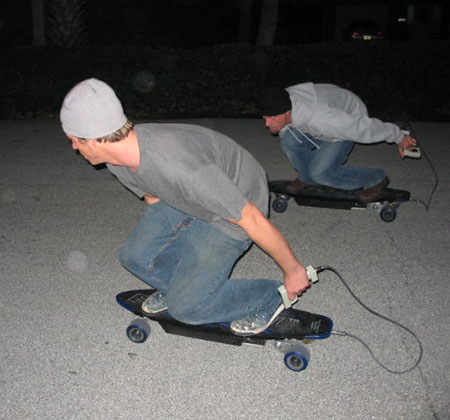
Many years ago, I saw an electric-powered skateboard in a sporting good store. I never saw such a thing again, but the image stuck in the back of my brain. Maybe it was still there when I dreamed up the hoverboards in Uglies.

I’d actually forgotten all about it, until I ran into this:

The company is called E-Glide, and it makes powered skateboards with the following specs:

0-20MPH in 4 seconds
10-15 mile range
about $500
about 40 pounds (18KG)
wired remote control
California attitude

So should I get one?

PROS
Would look like this video (warning: turn volume down if in school)
Save money on cabs
Save environment
Live life to fullest
Would write hoverboard scenes better
I need it

CONS
Expensive
Probably illegal in New York
Hard to bring on plane
Would have to grow soul patch
Last skateboard owned decades ago
Probable death

Please tell me what to do.

Breaking Elmore’s Rules

There’s a blog-meme going around about Elmore Leonard’s ten rules of writing. The Leonard Rules are pithy and fun, but I’ve found the meme oddly boring.

Why? Because everyone’s commentary about writing rules is pretty much the same: “Yes, that’s true, except when it’s not.” Or more detailed (and even more boring): “Following this rule would prevent beginning writers from making common mistakes, but many fine writers have eaten this rule for breakfast and shat gold before lunch.”

(Pardon my French on that last bit, but I spent last week in New Orleans. Mmmm . . . gumbo.)

So I thought I’d move beyond these generic comments and look specifically at how I break the Leonard Rules in my books. With examples!

Let’s start with Leonard’s opening caveat:

These are rules I’ve picked up along the way to help me remain invisible when I’m writing a book, to help me show rather than tell what’s taking place in the story. If you have a facility for language and imagery and the sound of your voice pleases you, invisibility is not what you are after, and you can skip the rules. Still, you might look them over.

Of course, most writers who set down rules start with something like, “These may work for you or not.” Well, duh.

But Leonard is saying something much more interesting, that every set of rules has an agenda. That’s the whole point of rules, actually: to ingrain some sort of aesthetic into the style of your prose. Leonard’s rules are designed to allow him to “remain invisible.” That is, he doesn’t want you thinking about the writing or the sound of his voice, just the characters and their situation. This makes sense, given that he’s writing hard-boiled crime fiction, where flights of literary fancy clog up the works.

So one of things I’ll be looking at below is how much I want to remain invisible as a writer. Short answer: I’m not writing tough-talking gumshoe fiction, so I don’t want to be as invisible as Elmore Leonard. But I don’t want to be slathered across every page, either.

Another nice feature of Leonard’s rules is their explanatory notes. These tend to get left out (sort of like that “well ordered militia” bit in the Second Amendment), so I’ve included his clarifications where I think they’re important.

Okay, here we go. Note that bold is Elmore Leonard, italics are quotations from my books, and normal text is me jabbering.

Rule 1. Never open a book with weather.

Hmm . . .

The early summer sky was the color of cat vomit. Uglies

Yeah, baby! I not only start with the weather; I start quarter-million-word trilogies with the weather. That’s how I roll.

But at least it’s weird weather: cat-vomit clouds! So you can already tell something funny is going on . . . probably in the point-of-view. Or as Elmore goes on to say in a well-armed-militia moment:

If it’s only to create atmosphere, and not a character’s reaction to the weather, you don’t want to go on too long. The reader is apt to leaf ahead looking for people.

Aha. And as Uglies continues in paragraph two:

Of course, Tally thought, you’d have to feed your cat only salmon-flavored cat food for a while, to get the pinks right. The scudding clouds did look a bit fishy, rippled into scales by a high-altitude wind. As the light faded, deep blue gaps of night peered through like an upside-down ocean, bottomless and cold.

Any other summer, a sunset like this would have been beautiful. But nothing had been beautiful since Peris turned pretty. Losing your best friend sucks, even if it’s only for three months and two days.

See? I’m not even breaking Rule 1. This cat-vomit sky is in someone’s head; the sky is actually quite beautiful, but Tally’s depression turns it ugly (so to speak).

And to return to Leonard’s overall agenda, starting with this glimpse of the weather through Tally’s eyes is probably more invisible that saying, “Tally was so depressed that the sky looked like cat-spew.”

Although that would have been funny too.

Rule 2. Avoid prologues. A prologue in a novel is backstory, and you can drop it in anywhere you want.

Yep, that’s me. I never start my YA books with prologues. I generally start with a big action scene of some kind (crashing a party, fighting a vampire, having time freeze) and then drop back to explain what’s going on during a lull in the action.

Of course, I don’t mind info-dumps, as we call them in science fiction. In fact, the even-numbered chapters in Peeps are all info-dumps. And unless fanmail lies, readers totally love that stuff.

As Leonard goes on to quote John Steinbeck, “Sometimes I want a book to break loose with a bunch of hooptedoodle. . . . Spin up some pretty words maybe or sing a little song with language. That’s nice. But I wish it was set aside so I don’t have to read it. I don’t want hooptedoodle to get mixed up with the story.”

Aha. That’s pretty much what Peeps does: it has special chapters where the parasite-related hooptedoodle lives. You can skip ahead and read all the parasite-hooptedoodle first, as some readers have told me they did, or skip past the parasite-hooptedoodle and sweep through the story first, as others prefered to do.

But here’s an interesting factoid: When I first turned in Peeps to my editors, the parasite-hooptedoodle chapters and story chapters were reversed from how they are now. That is, the first chapter (and all subsequent odd-numbered chapters) were hooptedoodle-icious. Which meant that the book started with that long description of a snail-eating parasite’s life-cycle: pure hooptedoodle prologue!

Without refrence to Elmore, my wise editors suggested that I swap them around, so that the book started with Cal fighting Sarah, his vampire-afflicted ex-girlfriend. And thus Rule 2 was followed.

It is with these small (but huge) changes that books are made better.

Okay, I’ve gone on a while here, and I’ve certainly typed the word “hooptedoddle” more times than I’d ever hoped to. So I’ll stop for today.

Next time, I’ll do Elmore’s Rules 3 and 4, those old stalwarts: Never use a verb other than “said” to carry dialogue and Never use an adverb to modify the verb “said.”

“Oh, crap,” Scott asseverated wolfishly. “I’m in big trouble now . . . ”

But look over there! It’s the freaky yet colorful eye-stalk of a parasitized snail!

See you next week.

The Big News

I’m still at ALA, and let me tell you that librarians rawk! We’re having a great time and meeting lots of excellent people. More about them later.

Because, of course, while I’m here away from computer and internet connections, The Big News has finally appeared!

From this week’s Variety:

As they prepare “Eragon” for a Dec. 15 release, 20th Century Fox and producer John Davis have bought into another young adult fantasy book series with “Uglies,” the Scott Westerfeld novel that hatches a trilogy.

Davis will produce with his wife, Jordan. Futuristic tale taps into teen angst over conformity and acceptance. Kids are called “Uglies” until they reach 16 and get surgically transformed into the attractive “Pretties,” who move to the glamorous part of town. A precocious teen is threatened with being denied the procedure unless she spies on a pal who skipped the operation and joined a rebellious group. Studio has bought the three-book series for a potential franchise. The second novel, “Pretties,” is near the top of the young adult bestseller lists; the IPG-repped Westerfeld’s third installment, “Specials,” was also released this year.

The producers were plugged into the tale by their daughter, who read the book in school. Studio has begun the search for a scribe to adapt.

Okay, actually, that’s only part of The Big News . . . more later, when I get back to my own computer!

Cool how the producers were clued into the books by their daughter. See? Word of mouth works!

Update: My agent has hard copy of the issue of Variety in hand, and it turns out the article was on page one. This is ego-boosting if nothing else.

For more discussion, the wheels are spinning here on westerboard.com.

Page 16

So those of you who live in the greater NY Times-reading metrosphere can see the listing of Specials finally committed to paper.

You see, although it’s been five weeks since I made the list, the Times only puts its children’s bestseller list on papyrus every 4-6 weeks! Because Specials listed right after the children’s list had been printed, I had to hang on for five weeks to see my name in newsprint.

Well, mission accomplished:

Note that newsprinty goodness. (It’s on page 16.)

Okay, enough about that.

On Friday, Justine and I head off for New Orleans and the ALA Annual Conference. I’ll be posting my schedule tomorrow for the librarians who read this blog. Can’t wait to see you guys there.

In New Orleans, I’ll be photoblogging a bit. I visited NOLA in 1991 and 2000 and had a great time, but I haven’t been there since Katrina. Can’t wait to discover what one of my favorite cities looks and feels like these days.

I’ll let you know.

Forums, Sampler, Fan Art (updated)

A bunch of Westerfeldian forums have sprung up all over the place lately, and have been mentioned in the comments, but I thought I’d link to them from here.

Westerboard.com just appeared and has been rocking, with discussions on all my books. [Update: This one has moved to this new link due to high demand. Update your bookmarks!]

This forum has been around a while, and is specifically about Midnighters.

Here’s the Westerfeld Fans Myspace site.

And the Westerfeld LiveJournal community.

Have I missed any? Let me know.

In other news, Simon & Schuster, publishers of Uglies, have created a free sampler of their fantasy authors. It includes an excerpt of Specials and nine other books:

SWASHBUCKLING FANTASY features excerpts from 10 series by bestselling and critically acclaimed authors such as Margaret Petersen Haddix, author of the Shadow Children series, D.J. MacHale, author of the Pendragon series, Scott Westerfeld, author of Uglies and Holly Black, author of Valiant. This online sampler also highlights six debut series from rising stars in fantasy, including Kai Meyer, Jane Johnson and Obert Skye. This fantasy sampler is the perfect way to introduce middle grade through teen readers to alternate worlds, distant pasts and fantastic creatures!

You can either take a look at the sampler or go straight to downloading.

Also, enjoy this lovely piece of fan art from Refrigerate Kate, which shows Tally hanging out in Diego.

I love the use of lighting to show that Tally’s sort of freaked out and alone.

And finally, for those of you who want to know what a tridecagram looks like, here’s one from . . . Alissa! And it came from the fan art section of Morgan’s site. Kewl.

Farewell, Surry Hills

So we lost the internet for two days thanks to a certain phone company being unspeakably lame. Sorry if I haven’t been posting, commenting, and answering email to your satisfaction.

Plus . . . moving!

We just left the Sydney flat, which was sadly empty and smelling of cleaning chemicals. We’re staying at the in-laws’ for two days before flying back to NYC. And now it is time to reminisce.

Sure, Specials may be at number 5 now. And yes, there’s that big news I’ve been promising you and not delivering, because I am a bad, bad man who drops hints and then is told by his agent that certain news is not public yet (grinds teeth).

But instead of discussing these things, I’m going to pause a moment to list all the things I’ll miss about Surry Hills.


The arched-tree promenade of Hyde Park, a mere five minutes’ walk away.


The glorious AMP Tower, seen at sunset out the glorious big window.


The telescope, which is staying here, alas. No more shall the moon be this cratered disk—orbalicious, blinding. Back to the mercury-vapor-pink skies of Manhattan.


The carnivorous plants of the nearby Botanical Gardens. You ate bugs so we didn’t have to, and yet we hardly knew ye.


The mighty Chesterfield, where much of Specials and The Last Days was penned. Plus, I loved that 6.4-meter ceiling.

Goodbye.

Last photo by Justine, all others by me.